Temnopleuridae
Temnopleuridae is a family of sea urchins in the infraorder Temnopleuridea.

Mindgrow (Jorg Ruwe) · CC BY-SA 2.0 · via Wikipedia/Commons. May be a photograph of a specimen, or an artist’s reconstruction — an interpretation of a skeleton, since colour and soft tissue are almost never preserved.
On record
Recorded, not inferred- Sits inside
- TemnopleurideaPBDB
- Diet
- grazer, deposit feederPBDB, for Echinoidea
- Life habit
- epifaunalPBDB, for Echinoidea
- Motility
- actively mobilePBDB, for Echinoidea
- Vision
- limitedPBDB, for Echinoidea
- Environment
- marinePBDB, for Echinodermata
Time the record covers
At least 41 million years on record.
The record covers at least 41.03 Mya to 11.7 ka. No occurrence read is dated outside 48.07 Mya to 0 Mya.
32 occurrences of Temnopleuridae on record, most of them in the Miocene. The Paleobiology Database records this as a living group. Bar height is expected occurrences, not a count: each fossil is spread across the span it is dated to, so a tall narrow bar means tight dating and a low wide one means loose.
When
32 occurrences- Eocene9%
- Miocene56%
- Pliocene4%
- Pleistocene28%
- Holocene3%
These are dates about fossils, not the animal: the record can only begin after it arose and end before it died out, so either end may reach further. Shares are expected occurrences: a fossil dated to a span is counted partly in each period it straddles. More on what this infers.
Found in
12 formations
- Narita Formation5
- Tokyo Formation3
- Glenforslan Formation2
- Borutta Formation2
- Island Sandstone Formation1
- Llajas Formation1
Loading coastlines…
The named rock units Temnopleuridae has been recovered from, largest first. Drawn where the rock is now, not where it formed. 12 occurrences have no formation on record, which is common for older literature.
Temnopleuridae and its relatives
MioceneWhere Temnopleuridae and its relatives were recorded in the Miocene.
Found in the same rock
279 taxa- Echinocyamus8 sites
- Echinolampas8 sites
- Genocidaris6 sites
- Clypeaster5 sites
- Spatangus5 sites
- Aequipecten4 sites
- Lovenia4 sites
- Prionocidaris4 sites
- Schizaster4 sites
- Temnopleurus hardwickii4 sites
- Amusium3 sites
- Brissopsis3 sites
- Brochopleurus3 sites
- Bryozoa3 sites
- Ostreoidea3 sites
- Pectinida3 sites
- Psammechinus3 sites
- Spondylus3 sites
- Temnopleurus toreumaticus3 sites
- Tylocidaris (Sardocidaris)3 sites
- Flabellum pavoninum2 sites
- Laganum depressum2 sites
- Lucina2 sites
- Myliobatis2 sites
The Paleobiology Database records 26 sites for Temnopleuridae, and this reads all of them. The number is how many of those sites it was catalogued from too. The 24 sharing the most are listed.
This is not a list of everything alive at the time. It is only what has come out of the same ground as this animal and been written down.
Entered from
14 references- The echinoid fauna from Japan and adjacent regions, Part I12
- Echinoid assemblages from the early Miocene of Funtanazza (Sardinia): A tool for reconstructing depositional environments along a shelf gradient5
- Palaeoecology and taphonomy of spatangoid-dominated echinoid assemblages: A case study from the Early-Middle Miocene of Sardinia, Italy2
- Two new Middle Miocene spatangoids (Echinoidea) from the Murray Basin, South Australia2
- Paleontologie de Madagascar. XIV. Fossiles du Miocene Marine2
- Echinoid assemblages as a tool for palaeoenvironmental reconstruction - an example from the Early Miocene of Egypt1
- Tertiary echinoids from Papua New Guinea1
- Additions to the Eocene megafossil fauna of the Llajas Formation, Simi Valley, southern California1
- Late Eocene decapod Crustacea from north Westland, South Island, New Zealand1
- Echinides éocènes et miocènes du Qatar (Golfe Persique)1
- A Miocene marine fauna from Zululand1
- Sur les oursins de l'Eocène moyen de Catalca-Karacaköy (Trakkya, Turquie)1
Each of the 32 occurrences read was entered from one of these publications, ordered by how many each accounts for. This is not a search for papers mentioning the name. 2 further references are not listed. Entries link to doi.org where the Paleobiology Database holds an identifier, and to its own record where it does not. Relayed as the Paleobiology Database holds them, not checked against what they resolve to.
Media and terms
Media content1
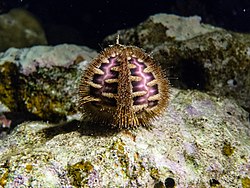
Picture of Temnopleuridae
- Source
- Wikipedia/Commons
- Credit
- Mindgrow (Jorg Ruwe)
- Licence
- CC BY-SA 2.0
- Commercial use
- the licence allows it
No 3D scan of Temnopleuridae was found in MorphoSource and Sketchfab.
Smithsonian Open Access was not reached for this taxon, so this list is what the others held rather than everything there is.
The description on this site
- Licence
- CC BY-SA 4.0
This is what the site found, which is not the same as what exists.
Keep going
What may have been alongside itTemnopleuridea through timeFormations of the MioceneThe world it lived on
Occurrence data from the Paleobiology Database, CC BY 4.0. Agassiz 1872