Terebratula terebratula
No picture of Terebratula terebratula was found. Wikipedia, Wikidata and iDigBio were searched and had none. Smithsonian Open Access did not answer, so this is what the others held rather than everything there is. GBIF was asked, and what came back is not recorded: nothing, or a picture this site could not tie to Terebratula terebratula, or no answer at all. This entry cannot say which.
On record
Recorded, not inferred- Sits inside
- TerebratulaPBDB
- Diet
- suspension feederPBDB, for Terebratulidae
- Life habit
- low-level epifaunalPBDB, for Terebratulidae
- Motility
- stationary, attachedPBDB, for Terebratulidae
- Vision
- blindPBDB, for Rhynchonellata
- Environment
- marinePBDB, for Lophophorata
Time the record covers
At least 2.7 million years on record.
The record covers at least 5.333 Mya to 2.58 Mya. No occurrence read is dated outside 7.246 Mya to 1.8 Mya.
24 occurrences of Terebratula terebratula on record, most of them in the Pliocene. Bar height is expected occurrences, not a count: each fossil is spread across the span it is dated to, so a tall narrow bar means tight dating and a low wide one means loose.
When
24 occurrences- Miocene8%
- Pliocene88%
- Pleistocene4%
These are dates about fossils, not the animal: the record can only begin after it arose and end before it died out, so either end may reach further. Shares are expected occurrences: a fossil dated to a span is counted partly in each period it straddles. More on what this infers.
Found in
2 formations
Loading coastlines…
The named rock units Terebratula terebratula has been recovered from, largest first. Drawn where the rock is now, not where it formed. 20 occurrences have no formation on record, which is common for older literature.
Terebratula terebratula and its relatives
PlioceneWhere Terebratula terebratula and its relatives were recorded in the Pliocene.
Found in the same rock
61 taxa- Aphelesia bipartita7 sites
- Megerlia eusticta4 sites
- Gryphus2 sites
- Terebratula ampulla2 sites
- Terebratula sinuosa2 sites
- Terebratulina retusa2 sites
- Acar1 site
- Aequipecten opercularis1 site
- Anadara (Anadara)1 site
- Anomia ephippium1 site
- Aphelesia margineplicata1 site
- Arca (Arca) tetragona1 site
- Arca noae1 site
- Arctica islandica1 site
- Barbatia (Barbatia)1 site
- Barbatia (Barbatia) barbata1 site
- Bathyarca1 site
- Bolma rugosus1 site
- Bulla striata1 site
- Cardium1 site
- Cardium hians1 site
- Chlamys1 site
- Chlamys (Chlamys) varia1 site
- Cidaris1 site
The Paleobiology Database records 22 sites for Terebratula terebratula, and this reads all of them. The number is how many of those sites it was catalogued from too. The 24 sharing the most are listed.
This is not a list of everything alive at the time. It is only what has come out of the same ground as this animal and been written down.
Entered from
9 references- Pliocene brachiopods from north-western Africa13
- Braquiópodos Pliocenos de Águilas3
- Sedimentology and palaeoecology of a Miocene coralline algal biostrome from the Maltese Islands2
- Two new Eucalathis (Brachiopoda, Chlidonophoridae) species from the Pliocene of Italy and history of the genus in the Mediterranean1
- Nota sobre Terebratulinae del Terciario de Europa y su relación con los representantes neógenos del sureste español1
- Pliocene brachiopods from the Estepona area (Málaga, South Spain)1
- Terebratula Müller, 1776 (Brachiopoda): proposed designation of Anomia terebratula Linnaeus, 1758 as the type species1
- Macrofauna del Pleistocene inferiore di Cinisi (Sicilia)1
- Linnaeus, 17581
Each of the 24 occurrences read was entered from one of these publications, ordered by how many each accounts for. This is not a search for papers mentioning the name. Entries link to doi.org where the Paleobiology Database holds an identifier, and to its own record where it does not. Relayed as the Paleobiology Database holds them, not checked against what they resolve to.
Media and terms
Media content1
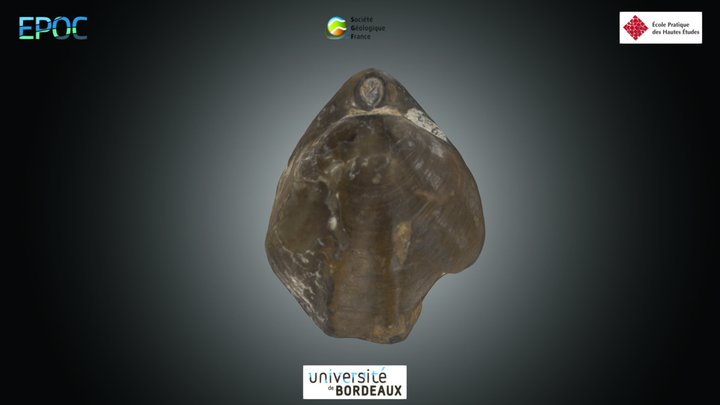
3D model
- Source
- Sketchfab
- Licence
- CC Attribution-NonCommercial-ShareAlike
- Commercial use
- the licence does not allow it
No picture of Terebratula terebratula was found. Wikipedia, Wikidata and iDigBio were searched and had none.
Smithsonian Open Access did not answer, so this is what the others held rather than everything there is.
GBIF was asked, and what came back is not recorded: nothing, or a picture this site could not tie to Terebratula terebratula, or no answer at all. This entry cannot say which.
Smithsonian Open Access was not reached for this taxon, so this list is what the others held rather than everything there is.
This is what the site found, which is not the same as what exists.
Keep going
What may have been alongside itTerebratula through timeFormations of the PlioceneThe world it lived on
Occurrence data from the Paleobiology Database, CC BY 4.0. (Linnaeus 1758)