Trachemys
Trachemys is a genus of turtles belonging to the family Emydidae. Members of this genus are native to the Americas, ranging from the Midwestern United States south to northern Argentina, but one subspecies, the red-eared slider, has been introduced worldwide. Species under this genus are commonly referred to as sliders.

Cepolina family and friends · Copyrighted free use · via Wikipedia/Commons. May be a photograph of a specimen, or an artist’s reconstruction — an interpretation of a skeleton, since colour and soft tissue are almost never preserved.
On record
Recorded, not inferred- Also called
- sliderPBDB
- Sits inside
- DeirochelyinaePBDB
- Diet
- omnivorePBDB, for Emydidae
- Life habit
- aquaticPBDB, for Emydidae
- Motility
- actively mobilePBDB, for Osteichthyes
- Environment
- freshwaterPBDB, for Emydidae
Time the record covers
At least 33 million years on record.
The record covers at least 33.9 Mya to 129 ka. No occurrence read is dated outside 37 Mya to 0 Mya.
41 occurrences of Trachemys on record, most of them in the Pleistocene. The Paleobiology Database records this as a living group. Bar height is expected occurrences, not a count: each fossil is spread across the span it is dated to, so a tall narrow bar means tight dating and a low wide one means loose.
When
41 occurrencesThese are dates about fossils, not the animal: the record can only begin after it arose and end before it died out, so either end may reach further. Shares are expected occurrences: a fossil dated to a span is counted partly in each period it straddles. More on what this infers.
Found in
13 formations
- Peace River Formation · Hawthorn Group2
- Kingsdown Formation1
- Alachua Formation1
- Bermont Formation1
- Fort Thompson Formation1
- Chadron Formation1
Loading coastlines…
The named rock units Trachemys has been recovered from, largest first. Drawn where the rock is now, not where it formed. 27 occurrences have no formation on record, which is common for older literature.
Trachemys and its relatives
PleistoceneWhere Trachemys and its relatives were recorded in the Pleistocene.
Found in the same rock
799 taxa- Alligator mississippiensis11 sites
- Chelydra serpentina10 sites
- Equus10 sites
- Hesperotestudo10 sites
- Lepisosteus9 sites
- Odocoileus virginianus9 sites
- Terrapene carolina9 sites
- Pseudemys8 sites
- Rana8 sites
- Apalone ferox7 sites
- Mammuthus columbi7 sites
- Procyon lotor7 sites
- Gopherus polyphemus6 sites
- Hesperotestudo crassiscutata6 sites
- Holmesina septentrionalis6 sites
- Kinosternon6 sites
- Mammut americanum6 sites
- Tapirus (Helicotapirus) veroensis6 sites
- Thamnophis6 sites
- Dasypus bellus5 sites
- Emydidae5 sites
- Neohipparion eurystyle5 sites
- Oryzomys palustris5 sites
- Paramylodon harlani5 sites
The Paleobiology Database records 35 sites for Trachemys, and this reads all of them. The number is how many of those sites it was catalogued from too. The 24 sharing the most are listed.
This is not a list of everything alive at the time. It is only what has come out of the same ground as this animal and been written down.
Entered from
33 references- Turtles of the early Pleistocene Santa Fe River 1B locality4
- The fossil turtles of North America3
- A new slider turtle (Testudines: Emydidae: Deirochelyinae: Trachemys) from the late Hemphillian (late Miocene/early Pliocene) of eastern Tennessee and the evolution of the deirochelyines2
- Fossil Kinosternidae from the Oligocene and Miocene of Florida, USA2
- Late Pleistocene megafaunal deposits on the isthmus of Panama and their paleoenvironmental implications2
- A new Miocene local fauna from the Sierra Madre Oriental at San Luis Potosí, Central-East Mexico, and its paleontologic significance1
- Testudinoidea Fitzinger (Testudines: Cryptodira) de la Formación Toropí/Yupoí (ca. 58-28 ka) en la provincia de Corrientes, Argentina: taxonomía y aspectos paleoambientales1
- Los fosiles de la Formacion Lagunilla del Plata (Pleistoceno tardio) Provincia de Cordoba, Argentina1
- A new early Pleistocene tapir (Mammalia: Perissodactyla) from Florida, with a review of Blancan tapirs from around the state1
- Research on fossil amphibians and reptiles in Mexico, from 1869 to early 2004 (including marine forms but excluding pterosaurs, dinosaurs, and obviously, birds)1
- Noteworthy turtle remains from the Late Miocene (Late Hemphillian) of northeastern Nebraska1
- The Pipe Creek Sinkhole biota, a diverse late Tertiary continental fossil assemblage from Grant County, Indiana1
Each of the 41 occurrences read was entered from one of these publications, ordered by how many each accounts for. This is not a search for papers mentioning the name. 21 further references are not listed. Entries link to doi.org where the Paleobiology Database holds an identifier, and to its own record where it does not. Relayed as the Paleobiology Database holds them, not checked against what they resolve to.
Media and terms
Media content2
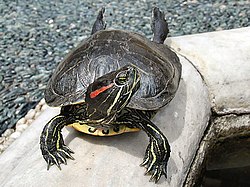
Picture of Trachemys
- Source
- Wikipedia/Commons
- Credit
- Cepolina family and friends
- Licence
- Copyrighted free use
- Commercial use
- cannot be read from the licence given — check the record
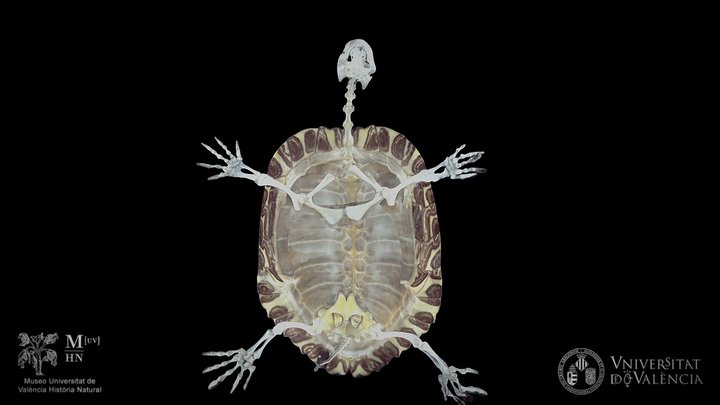
3D model
- Source
- Sketchfab
- Licence
- CC Attribution
- Commercial use
- cannot be read from the licence given — check the record
Smithsonian Open Access and MorphoSource were not reached for this taxon, so this list is what the others held rather than everything there is.
The description on this site
- Source
- Wikipedia, “Trachemys”
- Licence
- CC BY-SA 4.0
This is what the site found, which is not the same as what exists.
Keep going
What may have been alongside itDeirochelyinae through timeFormations of the PleistoceneThe world it lived on
Occurrence data from the Paleobiology Database, CC BY 4.0. Agassiz 1857