Chilomycterus

Cliff from I now live in Arlington, VA (Outside Washington DC), USA · CC BY 2.0 · via Wikidata/Commons. May be a photograph of a specimen, or an artist’s reconstruction — an interpretation of a skeleton, since colour and soft tissue are almost never preserved.
On record
Recorded, not inferred- Sits inside
- DiodontidaePBDB
- Diet
- carnivorePBDB, for Tetraodontiformes
- Life habit
- nektonicPBDB, for Tetraodontiformes
- Motility
- actively mobilePBDB, for Tetraodontiformes
Time the record covers
At least 14 million years on record.
The record covers at least 15.98 Mya to 1.8 Mya. No occurrence read is dated outside 23.04 Mya to 774 ka.
15 occurrences of Chilomycterus on record, most of them in the Miocene. The Paleobiology Database records this as a living group, and the chart stops with its fossils rather than at the present. Bar height is expected occurrences, not a count: each fossil is spread across the span it is dated to, so a tall narrow bar means tight dating and a low wide one means loose.
When
15 occurrences- Miocene65%
- Pliocene15%
- Pleistocene20%
These are dates about fossils, not the animal: the record can only begin after it arose and end before it died out, so either end may reach further. Shares are expected occurrences: a fossil dated to a span is counted partly in each period it straddles. More on what this infers.
Found in
10 formations
- Alachua Formation1
- Yorktown Formation · Chesapeake Group1
- Pungo River Formation1
- Bolognano Formation1
- Choptank Formation · Chesapeake Group1
- St. Marys Formation · Chesapeake Group1
Loading coastlines…
The named rock units Chilomycterus has been recovered from, largest first. Drawn where the rock is now, not where it formed. 5 occurrences have no formation on record, which is common for older literature.
Chilomycterus and its relatives
MioceneWhere Chilomycterus and its relatives were recorded in the Miocene.
Found in the same rock
1,055 taxa- Hemipristis serra8 sites
- Carcharodon hastalis7 sites
- Carcharhinus leucas6 sites
- Carcharias taurus6 sites
- Lagodon rhomboides6 sites
- Galeocerdo cuvier5 sites
- Isurus oxyrinchus5 sites
- Negaprion brevirostris5 sites
- Otodus megalodon5 sites
- Sphyraena barracuda5 sites
- Aetobatus4 sites
- Carcharhinus4 sites
- Carcharodon carcharias4 sites
- Myliobatis4 sites
- Negaprion eurybathrodon4 sites
- Physogaleus contortus4 sites
- Pogonias cromis4 sites
- Alopias vulpinus3 sites
- Alosa elongata3 sites
- Aluterus3 sites
- Bolivina3 sites
- Bregmaceros albyi3 sites
- Carcharhinus perezi3 sites
- Carcharhinus plumbeus3 sites
The Paleobiology Database records 14 sites for Chilomycterus, and this reads all of them. The number is how many of those sites it was catalogued from too. The 24 sharing the most are listed.
This is not a list of everything alive at the time. It is only what has come out of the same ground as this animal and been written down.
Entered from
12 references- Geology and biostratigraphy of the Potomac River Cliffs at Stratford Hall, Westmoreland County, Virginia2
- The Neogene sharks, rays, and bony fishes from Lee Creek Mine, Aurora, North Carolina2
- Messinian marine fish communities of the Mediterranean Sea2
- Gigantic burrfish (Tetraodontiformes: Diodontidae) tooth plate batteries from the Pliocene Yorktown Formation on the submerged continental shelf, North Carolina, U.S.A.1
- Underwater paleontology inside cenotes reveals the Miocene-Pliocene fish diversity in the Yucatan Peninsula, southeast Mexico1
- Youngest record of the extinct walrus Ontocetus emmonsi from the Early Pleistocene of South Carolina and a review of North Atlantic walrus biochronology1
- Paléobiodiversité et paléoenvironnements: l’exemple des gisements de poissons téléostéens du Messinien préévaporitique d’Oran et du bassin du Chélif (Algérie)1
- Early Miocene vertebrates from Montagna della Maiella, Italy1
- Chondrichthyes and Osteichthyes from the early Pleistocene Leisey Shell Pit local fauna, Hillsborough County, Florida1
- La stratigraphie du remplissage de la Grotte du Vallonnet.1
- Geology and paleontology of the Love Bone Bed from the Late Miocene of Florida1
- Synopsis des poissons tertiaires de Licata1
Each of the 15 occurrences read was entered from one of these publications, ordered by how many each accounts for. This is not a search for papers mentioning the name. Entries link to doi.org where the Paleobiology Database holds an identifier, and to its own record where it does not. Relayed as the Paleobiology Database holds them, not checked against what they resolve to.
Media and terms
Media content3
Picture of Chilomycterus
- Source
- Wikidata/Commons
- Credit
- Cliff from I now live in Arlington, VA (Outside Washington DC), USA
- Licence
- CC BY 2.0
- Commercial use
- the licence allows it

CT scan
- Source
- MorphoSource
- Licence
- In Copyright
- Commercial use
- cannot be read from the licence given — check the record
- Specimen
- Chilomycterus antennatus · FMNH:Fishes:55185
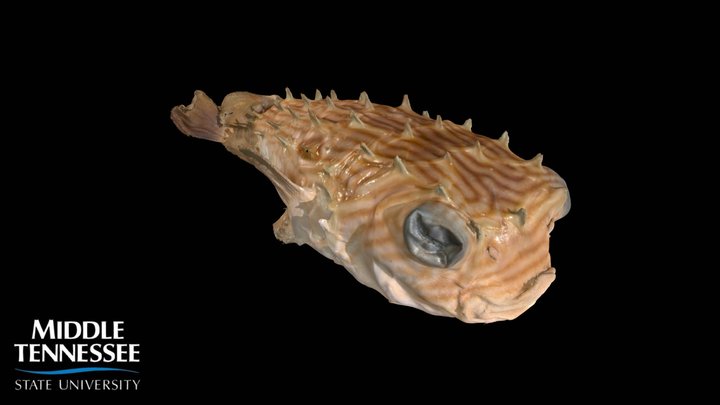
3D model
- Source
- Sketchfab
- Credit
- MTSUichthyology
- Licence
- CC Attribution
- Commercial use
- cannot be read from the licence given — check the record
Smithsonian Open Access was not reached for this taxon, so this list is what the others held rather than everything there is.
This is what the site found, which is not the same as what exists.
Keep going
What may have been alongside itDiodontidae through timeFormations of the MioceneThe world it lived on
Occurrence data from the Paleobiology Database, CC BY 4.0. Brisout de Barneville 1846