Deirochelyinae
The Deirochelyinae are a subfamily of the Emydidae consisting of species native to North and South America, some of which are frequently kept as pets. As a result of pet trade, one species, the red-eared slider, can now be found in many parts of the world.

André Karwath aka Aka · CC BY-SA 2.5 · via Wikipedia/Commons. May be a photograph of a specimen, or an artist’s reconstruction — an interpretation of a skeleton, since colour and soft tissue are almost never preserved.
On record
Recorded, not inferred- Sits inside
- EmydidaePBDB
- Diet
- omnivorePBDB, for Emydidae
- Life habit
- aquaticPBDB, for Emydidae
- Motility
- actively mobilePBDB, for Osteichthyes
- Environment
- freshwaterPBDB, for Emydidae
Time the record covers
At least 48 million years on record.
The record covers at least 48.07 Mya to 11.7 ka. No occurrence read is dated outside 56 Mya to 0 Mya.
115 occurrences of Deirochelyinae on record, most of them in the Pleistocene. The Paleobiology Database records this as a living group. Bar height is expected occurrences, not a count: each fossil is spread across the span it is dated to, so a tall narrow bar means tight dating and a low wide one means loose.
When
115 occurrencesThese are dates about fossils, not the animal: the record can only begin after it arose and end before it died out, so either end may reach further. Shares are expected occurrences: a fossil dated to a span is counted partly in each period it straddles. More on what this infers.
Found in
25 formations
- Valentine Formation · Ogallala Group6
- Alachua Formation3
- Ash Hollow Formation3
- Kingsdown Formation2
- Long Pine Formation2
- Yorktown Formation · Chesapeake Group2
Loading coastlines…
The named rock units Deirochelyinae has been recovered from, largest first. Drawn where the rock is now, not where it formed. One further formation holds fewer occurrences and is not listed. 73 occurrences have no formation on record, which is common for older literature.
Deirochelyinae and its relatives
PleistoceneWhere Deirochelyinae and its relatives were recorded in the Pleistocene.
Found in the same rock
2,010 taxa- Equus20 sites
- Rana20 sites
- Odocoileus virginianus19 sites
- Alligator mississippiensis17 sites
- Chrysemys17 sites
- Lepisosteus17 sites
- Trachemys17 sites
- Chelydra serpentina16 sites
- Thamnophis15 sites
- Hesperotestudo14 sites
- Terrapene carolina14 sites
- Nerodia13 sites
- Procyon lotor13 sites
- Bufo12 sites
- Chrysemys picta12 sites
- Dasypus bellus12 sites
- Mammut americanum12 sites
- Tapirus12 sites
- Trachemys scripta12 sites
- Emydidae10 sites
- Holmesina septentrionalis10 sites
- Kinosternon10 sites
- Mammuthus columbi10 sites
- Paramylodon harlani10 sites
The Paleobiology Database records 86 sites for Deirochelyinae, and this reads all of them. The number is how many of those sites it was catalogued from too. The 24 sharing the most are listed.
This is not a list of everything alive at the time. It is only what has come out of the same ground as this animal and been written down.
Entered from
70 references- Miocene and Pliocene Chelonians from the Calvert Cliffs and Nearby Regions5
- The status of Emydoidea hutchisoni Holman, 1995 (Testudines: Emydidae). (Note)5
- Turtles of the early Pleistocene Santa Fe River 1B locality4
- An extinct map turtle Graptemys (Testudines, Emydidae) from the Late Pleistocene of Florida4
- Amphibians and nonmarine turtles from the Miocene Calvert Formation of Delaware, Maryland, and Virginia (USA)3
- The fossil record of the diamond-backed terrapin, Malaclemys terrapin (Testudines: Emydidae)3
- A Late Pleistocene Hepetofauna from Clark Quarry, Glynn County, Georgia3
- Pleistocene (Rancholabrean) vertebrate faunas from coastal Georgia3
- Herpetofaunas of the Big Springs and Hornet's Nest quarries (northeastern Nebraska, Pleistocene: Late Blancan)3
- The fossil turtles of North America3
- A new slider turtle (Testudines: Emydidae: Deirochelyinae: Trachemys) from the late Hemphillian (late Miocene/early Pliocene) of eastern Tennessee and the evolution of the deirochelyines2
- The geology and paleontology of Ashfall Fossil Beds, a late Miocene (Clarendonian) mass-death assemblage, Antelope County and adjacent Knox County, Nebraska, USA2
Each of the 115 occurrences read was entered from one of these publications, ordered by how many each accounts for. This is not a search for papers mentioning the name. 58 further references are not listed. Entries link to doi.org where the Paleobiology Database holds an identifier, and to its own record where it does not. Relayed as the Paleobiology Database holds them, not checked against what they resolve to.
Media and terms
Media content1
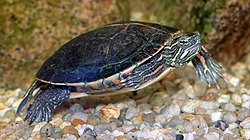
Picture of Deirochelyinae
- Source
- Wikipedia/Commons
- Credit
- André Karwath aka Aka
- Licence
- CC BY-SA 2.5
- Commercial use
- the licence allows it
No 3D scan of Deirochelyinae was found in Sketchfab.
Smithsonian Open Access and MorphoSource were not reached for this taxon, so this list is what the others held rather than everything there is.
The description on this site
- Licence
- CC BY-SA 4.0
This is what the site found, which is not the same as what exists.
Keep going
What may have been alongside itEmydidae through timeFormations of the PleistoceneThe world it lived on
Occurrence data from the Paleobiology Database, CC BY 4.0. Agassiz 1857