Globicephala melas
Pilot whales are cetaceans belonging to the genus Globicephala. The two extant species are the long-finned pilot whale and the short-finned pilot whale. The two are not readily distinguishable at sea, and analysis of the skulls is the best way to distinguish between the species. Between the two species, they range nearly worldwide, with long-finned pilot whales living in colder waters and short-finned pilot whales living in tropical and subtropical waters. Pilot whales are among the largest of the oceanic dolphins, exceeded in size only by the orca. They and other large members of the dolphin family are also known as blackfish.

NOAA Photo Library · Public Domain · via Wikipedia/Commons. May be a photograph of a specimen, or an artist’s reconstruction — an interpretation of a skeleton, since colour and soft tissue are almost never preserved.
On record
Recorded, not inferred- Also called
- long-finned pilot whalePBDB
- Sits inside
- GlobicephalaPBDB
- Diet
- piscivore, carnivorePBDB, for Delphinidae
- Life habit
- aquatic, depth=surfacePBDB, for Cetacea
- Motility
- actively mobilePBDB, for Cetacea
- Environment
- marine,freshwaterPBDB, for Odontoceti
Time the record covers
At least 762 thousand years on record.
The record covers at least 774 ka to 11.7 ka. No occurrence read is dated outside 7.246 Mya to 0 Mya.
11 occurrences of Globicephala melas on record. The Paleobiology Database records this as a living group. Bar height is expected occurrences, not a count: each fossil is spread across the span it is dated to, so a tall narrow bar means tight dating and a low wide one means loose.
When
11 occurrences- Miocene3%
- Pliocene4%
- Pleistocene12%
- Holocene82%
These are dates about fossils, not the animal: the record can only begin after it arose and end before it died out, so either end may reach further. Shares are expected occurrences: a fossil dated to a span is counted partly in each period it straddles. More on what this infers.
Found in the same rock
59 taxa- Acipenser1 site
- Alces1 site
- Anancus arvernensis1 site
- Balaena1 site
- Balaenidae1 site
- Balaenoptera musculus1 site
- Balaenoptera physalus1 site
- Balaenopteridae1 site
- Balaenotus1 site
- Bison priscus1 site
- Bos taurus1 site
- Capra hircus1 site
- Cetotherium1 site
- Coelodonta antiquitatis1 site
- Coronula diadema1 site
- Crocuta crocuta spelaea1 site
- Delphinapterus1 site
- Delphinapterus leucas1 site
- Delphinidae1 site
- Dentaliidae1 site
- Equus1 site
- Eucladoceros ctenoides1 site
- Grampus1 site
- Halichoerus grypus1 site
The Paleobiology Database records 11 sites for Globicephala melas, and this reads all of them. The number is how many of those sites it was catalogued from too. The 24 sharing the most are listed.
This is not a list of everything alive at the time. It is only what has come out of the same ground as this animal and been written down.
Entered from
7 references- Determining the ages of sub-fossil cetacean remains, found in the Carse of Stirling, Scotland3
- Foraging behaviour and ecology of transient killer whales (Orcinus orca)3
- The Kor & Bot collection revisited, with a biostratigraphic interpretation of the Early Pleistocene Oosterschelde Fauna (Oosterschelde Estuary, the Netherlands)1
- Ressources complémentaires et mobilité dans le Magdalénien cantabrique. Nouvelles données sur les mammifères marins, les crustacés, les mollusques et les roches organogènes de la Grotte de Las Caldas (Asturies, Espagne)1
- Povoado muculmano na Ponta do Castelo (Aljezur)1
- Catalog of Living Whales1
- Lydekker, 18871
Each of the 11 occurrences read was entered from one of these publications, ordered by how many each accounts for. This is not a search for papers mentioning the name. Entries link to doi.org where the Paleobiology Database holds an identifier, and to its own record where it does not. Relayed as the Paleobiology Database holds them, not checked against what they resolve to.
Media and terms
Media content2

Picture of Globicephala melas
- Source
- Wikipedia/Commons
- Credit
- NOAA Photo Library
- Licence
- Public Domain
- Commercial use
- the licence allows it
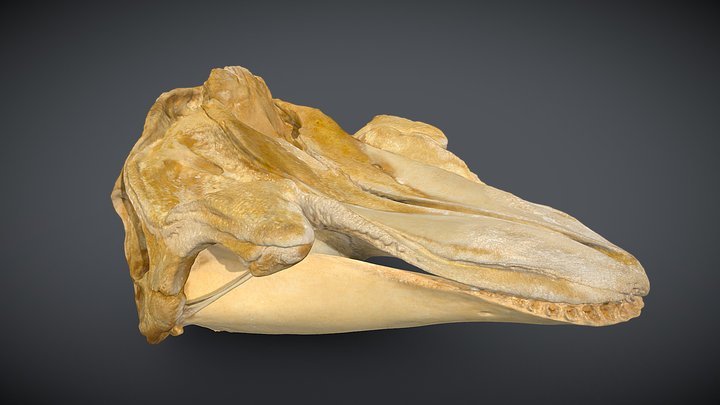
3D model
- Source
- Sketchfab
- Licence
- CC Attribution-NonCommercial-NoDerivs
- Commercial use
- the licence does not allow it
Smithsonian Open Access and MorphoSource were not reached for this taxon, so this list is what the others held rather than everything there is.
The description on this site
- Source
- Wikipedia, “Pilot whale”
- Licence
- CC BY-SA 4.0
This is what the site found, which is not the same as what exists.
Keep going
What may have been alongside itGlobicephala through timeThe world it lived on
Occurrence data from the Paleobiology Database, CC BY 4.0. (Traill 1809)