Leptobos
Leptobos is an extinct genus of large bovines, known from the Late Pliocene and Early Pleistocene of Eurasia, extending from the Iberian Peninsula and Britain to the Indian subcontent and northern China. It is widely posited to be the ancestor of bison.

Uncredited · via Wikipedia/Commons. May be a photograph of a specimen, or an artist’s reconstruction — an interpretation of a skeleton, since colour and soft tissue are almost never preserved.
On record
Recorded, not inferred- Sits inside
- BovidaePBDB
- Diet
- grazer, browserPBDB, for Bovidae
- Life habit
- ground dwellingPBDB, for Bovidae
- Motility
- actively mobilePBDB, for Osteichthyes
- Environment
- terrestrialPBDB, for Artiodactyla
Time the record covers
At least 3.4 million years on record.
The record covers at least 3.6 Mya to 129 ka. No occurrence read is dated outside 7.246 Mya to 11.7 ka.
72 occurrences of Leptobos on record, most of them in the Pleistocene. Bar height is expected occurrences, not a count: each fossil is spread across the span it is dated to, so a tall narrow bar means tight dating and a low wide one means loose.
When
72 occurrences- Mioceneunder 1%
- Pliocene26%
- Pleistocene73%
These are dates about fossils, not the animal: the record can only begin after it arose and end before it died out, so either end may reach further. Shares are expected occurrences: a fossil dated to a span is counted partly in each period it straddles. More on what this infers.
Found in
9 formations
- Gerakarou Formation · Premygdonian Group2
- Santa Maria di Ciciliano Formation2
- Via Cortina d'Ampezzo Formation1
- Kairubak suite Formation1
- Ponte Naja Formation1
- Tatrot Formation · Siwalik Group1
Loading coastlines…
The named rock units Leptobos has been recovered from, largest first. Drawn where the rock is now, not where it formed. 61 occurrences have no formation on record, which is common for older literature.
Leptobos and its relatives
PleistoceneWhere Leptobos and its relatives were recorded in the Pleistocene.
Found in the same rock
561 taxa- Allohippus stenonis34 sites
- Mammuthus meridionalis31 sites
- Stephanorhinus etruscus31 sites
- Eucladoceros27 sites
- Equus22 sites
- Gazella20 sites
- Cervus19 sites
- Canis etruscus18 sites
- Anancus arvernensis16 sites
- Mimomys15 sites
- Ursus etruscus15 sites
- Gazellospira14 sites
- Croizetoceros ramosus13 sites
- Lynx issiodorensis13 sites
- Acinonyx pardinensis11 sites
- Pachycrocuta brevirostris11 sites
- Sus strozzii11 sites
- Chasmaporthetes lunensis10 sites
- Metacervocerus10 sites
- Canis9 sites
- Cervidae9 sites
- Hystrix9 sites
- Metacervocerus philisi9 sites
- Oryctolagus9 sites
The Paleobiology Database records 69 sites for Leptobos, and this reads all of them. The number is how many of those sites it was catalogued from too. The 24 sharing the most are listed.
This is not a list of everything alive at the time. It is only what has come out of the same ground as this animal and been written down.
Entered from
49 references- The Villafranchian mammalian faunas and biochronology of Greece11
- Principaux gisements villafranchiens de France: Listes fauniques et biostratigraphie6
- Elementi di paleobiogeographia dei mammiferi Terziari dell Italia.3
- Revision of the historical collections of Pliocene-Pleistocene large mammals from Le Riège and Saint-Palais localities, near Pézenas (Southern France)2
- The Kor & Bot collection revisited, with a biostratigraphic interpretation of the Early Pleistocene Oosterschelde Fauna (Oosterschelde Estuary, the Netherlands)2
- Large mammal fossil occurrences and associated archaeological evidence in Pleistocene contexts of peninsular India and Sri Lanka2
- The section of Torre Picchio (Terni, Umbria, Central Italy): A Villafranchian site rich in vertebrates, molluscs, ostracods and plants.2
- Preliminary report on the late Pliocene fauna from Vatera (Lesvos, Greece)2
- Villafranchian faunal record of Spain2
- Biochronology and evolution of the Early Pliocene to the Early Pleistocene mammalian faunas of Romania1
- Fossil equids (Mammalia, Equidae) from the Neogene and Pleistocene of Tadzhikistan1
- Dursunlu - a new Lower Pleistocene faunal and artifact-bearing locality in southern Anatolia.1
Each of the 72 occurrences read was entered from one of these publications, ordered by how many each accounts for. This is not a search for papers mentioning the name. 37 further references are not listed. Entries link to doi.org where the Paleobiology Database holds an identifier, and to its own record where it does not. Relayed as the Paleobiology Database holds them, not checked against what they resolve to.
Media and terms
Media content1
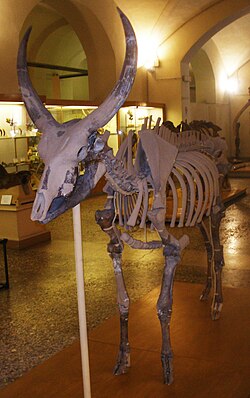
Picture of Leptobos
- Source
- Wikipedia/Commons
- Credit
- nobody named on the record
- Licence
- not stated by the source
- Commercial use
- cannot be read from the licence given — check the record
No 3D scan of Leptobos was found in Sketchfab.
Smithsonian Open Access and MorphoSource were not reached for this taxon, so this list is what the others held rather than everything there is.
The description on this site
- Source
- Wikipedia, “Leptobos”
- Licence
- CC BY-SA 4.0
This is what the site found, which is not the same as what exists.
Keep going
What may have been alongside itBovidae through timeFormations of the PleistoceneThe world it lived on
Occurrence data from the Paleobiology Database, CC BY 4.0. Rutimeyer 1878