Miracinonyx trumani
Miracinonyx, colloquially known as the American cheetah, is an extinct genus of feline that was native to North America during the Pliocene and Pleistocene epoch. Its closest living relative is the cougar, while its anatomical similarities to the modern cheetah are possibly a result of convergent evolution, the development of analogous physical traits between distinct, not closely related species with a shared ancestry due to facing similar environmental pressures.

Edward Drinker Cope (1899) · Public Domain · via Wikipedia/Commons. May be a photograph of a specimen, or an artist’s reconstruction — an interpretation of a skeleton, since colour and soft tissue are almost never preserved.
On record
Recorded, not inferred- Sits inside
- MiracinonyxPBDB
- Diet
- carnivorePBDB, for Felidae
- Life habit
- scansorialPBDB, for Felidae
- Motility
- actively mobilePBDB, for Osteichthyes
- Environment
- terrestrialPBDB, for Eutheria
Time the record covers
At most 199 thousand years on record.
Every occurrence read is dated to somewhere between 210 ka and 11.7 ka, and nothing in the dating separates them, so that window is what the record shows rather than a span.
3 occurrences of Miracinonyx trumani on record, most of them in the Pleistocene. Bar height is expected occurrences, not a count: each fossil is spread across the span it is dated to, so a tall narrow bar means tight dating and a low wide one means loose.
When
3 occurrences- Pleistocene100%
These are dates about fossils, not the animal: the record can only begin after it arose and end before it died out, so either end may reach further. Shares are expected occurrences: a fossil dated to a span is counted partly in each period it straddles. More on what this infers.
Miracinonyx trumani and its relatives
PleistoceneWhere Miracinonyx trumani and its relatives were recorded in the Pleistocene.
Found in the same rock
58 taxa- Aenocyon dirus2 sites
- Antilocapra americana2 sites
- Equus2 sites
- Lepus2 sites
- Microtus2 sites
- Neotoma2 sites
- Ovis canadensis2 sites
- Panthera leo atrox2 sites
- Sylvilagus2 sites
- Vulpes vulpes2 sites
- Arctodus simus1 site
- Bison antiquus antiquus1 site
- Bootherium bombifrons1 site
- Bos bison1 site
- Bufo1 site
- Buteo1 site
- Camelops1 site
- Caninae1 site
- Canis latrans1 site
- Canis lupus1 site
- Cervidae1 site
- Cervus canadensis1 site
- Erethizon dorsatum1 site
- Eutamias1 site
The Paleobiology Database records 3 sites for Miracinonyx trumani, and this reads all of them. The number is how many of those sites it was catalogued from too. The 24 sharing the most are listed.
This is not a list of everything alive at the time. It is only what has come out of the same ground as this animal and been written down.
Entered from
3 references- Cenozoic vertebrate biostratigraphy of South Carolina, U.S.A. and additions to the fauna1
- Natural Trap Cave1
- Late Pleistocene vertebrates from Gunnison County, Colorado1
Each of the 3 occurrences read was entered from one of these publications, ordered by how many each accounts for. This is not a search for papers mentioning the name. Each entry links to doi.org. Relayed as the Paleobiology Database holds them, not checked against what they resolve to.
Media and terms
Media content3

Picture of Miracinonyx trumani
- Source
- Wikipedia/Commons
- Credit
- Edward Drinker Cope (1899)
- Licence
- Public Domain
- Commercial use
- the licence allows it
Laser scan
- Source
- MorphoSource
- Licence
- In Copyright
- Commercial use
- cannot be read from the licence given — check the record
- Specimen
- Miracinonyx trumani · ku:kuvp:435639
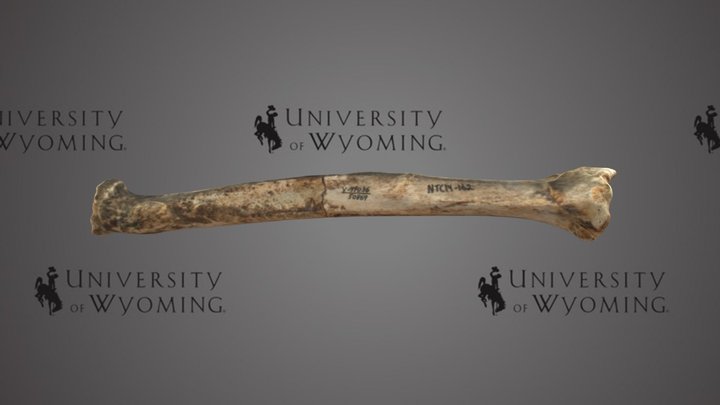
3D model
- Source
- Sketchfab
- Licence
- CC Attribution-NonCommercial
- Commercial use
- the licence does not allow it
Smithsonian Open Access was not reached for this taxon, so this list is what the others held rather than everything there is.
The description on this site
- Source
- Wikipedia, “Miracinonyx”
- Licence
- CC BY-SA 4.0
This is what the site found, which is not the same as what exists.
Keep going
What may have been alongside itMiracinonyx through timeFormations of the PleistoceneThe world it lived on
Occurrence data from the Paleobiology Database, CC BY 4.0. (Orr 1969)