Bos bison
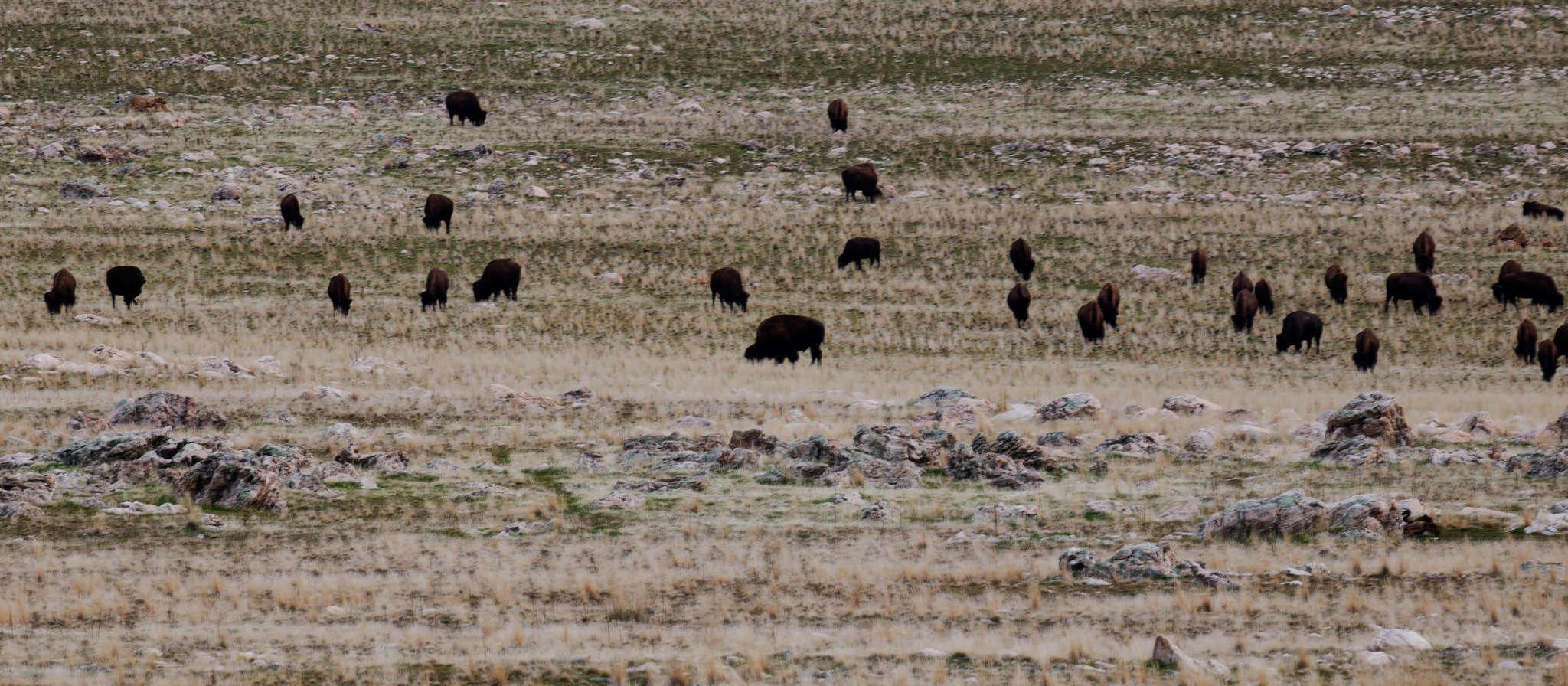
Not Bos bison. This is Bos bison Linnaeus, 1758, a relative — both are Bovidae.
Daughter Dad · CC BY 4.0 · via GBIF. May be a photograph of a specimen, or an artist’s reconstruction — an interpretation of a skeleton, since colour and soft tissue are almost never preserved.
On record
Recorded, not inferred- Also called
- American bisonPBDB
- Sits inside
- BosPBDB
- Diet
- grazer, browserPBDB, for Bovidae
- Life habit
- ground dwellingPBDB, for Bovidae
- Motility
- actively mobilePBDB, for Osteichthyes
- Environment
- terrestrialPBDB, for Artiodactyla
Time the record covers
At least 2 thousand years on record.
The record covers at least 14 ka to 11.7 ka. No occurrence read is dated outside 2.58 Mya to 0 Mya.
18 occurrences of Bos bison on record, most of them in the Pleistocene. The Paleobiology Database records this as a living group. Bar height is expected occurrences, not a count: each fossil is spread across the span it is dated to, so a tall narrow bar means tight dating and a low wide one means loose.
When
18 occurrences- Pleistocene83%
- Holocene17%
These are dates about fossils, not the animal: the record can only begin after it arose and end before it died out, so either end may reach further. Shares are expected occurrences: a fossil dated to a span is counted partly in each period it straddles. More on what this infers.
Found in
1 formation
Loading coastlines…
The named rock units Bos bison has been recovered from, largest first. Drawn where the rock is now, not where it formed. 17 occurrences have no formation on record, which is common for older literature.
Bos bison and its relatives
PleistoceneWhere Bos bison and its relatives were recorded in the Pleistocene.
Found in the same rock
121 taxa- Equus7 sites
- Mammut americanum6 sites
- Canis latrans4 sites
- Cervus canadensis4 sites
- Homo sapiens4 sites
- Mammuthus4 sites
- Odocoileus virginianus4 sites
- Bison antiquus3 sites
- Camelops3 sites
- Canis lupus3 sites
- Castoroides ohioensis3 sites
- Mammuthus columbi3 sites
- Tapirus (Helicotapirus) haysii3 sites
- Vulpes vulpes3 sites
- Antilocapra americana2 sites
- Bootherium bombifrons2 sites
- Canis familiaris2 sites
- Cervidae2 sites
- Cervus2 sites
- Crocodylus2 sites
- Equus complicatus2 sites
- Eutamias2 sites
- Gulo gulo2 sites
- Lepus americanus2 sites
The Paleobiology Database records 18 sites for Bos bison, and this reads all of them. The number is how many of those sites it was catalogued from too. The 24 sharing the most are listed.
This is not a list of everything alive at the time. It is only what has come out of the same ground as this animal and been written down.
Entered from
13 references- New Quaternary mammal localities in the upper Clark Fork River valley, western Montana4
- Early Projectile Points and Pleistocene Fauna from Sandpits near Wichita, Kansas3
- First fossil manatees in Texas, USA: Trichechus manatus bakerorum from Pleistocene beach deposits along the Gulf of Mexico1
- Mammoth steps: an overview of the fauna of Wally’s Beach (DhPg-8), a late Pleistocene locality from southwestern Alberta1
- Natural Trap Cave1
- Emergent Pliocene and Pleistocene sediments of southeastern Georgia: an anomalous, fossil-poor, clastic section1
- Ice Age Vertebrates in the Canadian Arctic Islands1
- Virginia Division of Mineral Resources1
- Fossil and subfossil mammals from the Quaternary of British Columbia1
- Roebuck Prehistoric Village Site, Grenville County, Ontario1
- Description of remains of Bison occidentalis from central Minnesota1
- Descriptions of some Pleistocene vertebrates found in the United States1
Each of the 18 occurrences read was entered from one of these publications, ordered by how many each accounts for. This is not a search for papers mentioning the name. 1 further reference is not listed. Entries link to doi.org where the Paleobiology Database holds an identifier, and to its own record where it does not. Relayed as the Paleobiology Database holds them, not checked against what they resolve to.
Media and terms
Media content1
Picture of Bos bison Linnaeus, 1758
- Source
- GBIF
- Credit
- Daughter Dad
- Licence
- CC BY 4.0
- Commercial use
- the licence allows it
No repository was searched for a 3D scan: the genus name is too short to search on without matching most of the record.
This is what the site found, which is not the same as what exists.
Keep going
What may have been alongside itBos through timeFormations of the PleistoceneThe world it lived on
Occurrence data from the Paleobiology Database, CC BY 4.0. (Linnaeus 1758)