Monodon
The narwhal is a species of toothed whale native to the Arctic. It is the only member of the genus Monodon and one of two living representatives of the family Monodontidae. The narwhal is a stocky cetacean with a relatively blunt snout, a large melon, and a shallow ridge in place of a dorsal fin. Males of this species have a spiralled tusk that is 1.5–3.0 m (4.9–9.8 ft) long, which is a protruding left canine thought to function as a weapon, a tool for feeding, in attracting mates or sensing water salinity. Specially adapted slow-twitch muscles, along with the jointed neck vertebrae and shallow dorsal ridge allow for easy movement through the Arctic environment, where the narwhal spends extended periods at great depths. The narwhal's geographic range overlaps with that of the similarly built and closely related beluga whale, and the animals are known to interbreed.

пресс-служба ПАО "Газпром нефть" · CC BY-SA 4.0 · via Wikipedia/Commons. May be a photograph of a specimen, or an artist’s reconstruction — an interpretation of a skeleton, since colour and soft tissue are almost never preserved.
On record
Recorded, not inferred- Also called
- narwhalPBDB
- Sits inside
- MonodontidaePBDB
- Diet
- piscivorePBDB, for Monodontidae
- Life habit
- aquatic, depth=surfacePBDB, for Cetacea
- Motility
- actively mobilePBDB, for Cetacea
- Environment
- marine,freshwaterPBDB, for Odontoceti
Time the record covers
At least 3.5 million years on record.
The record covers at least 3.6 Mya to 11.7 ka. No occurrence read is dated outside 7.246 Mya to 0 Mya.
28 occurrences of Monodon on record. The Paleobiology Database records this as a living group. Bar height is expected occurrences, not a count: each fossil is spread across the span it is dated to, so a tall narrow bar means tight dating and a low wide one means loose.
When
28 occurrences- Miocene1%
- Pliocene5%
- Pleistocene30%
- Holocene64%
These are dates about fossils, not the animal: the record can only begin after it arose and end before it died out, so either end may reach further. Shares are expected occurrences: a fossil dated to a span is counted partly in each period it straddles. More on what this infers.
Found in
3 formations
- Cromer Forest Bed Formation2
- Yorktown Formation · Chesapeake Group1
- Red Crag Formation1
Loading coastlines…
The named rock units Monodon has been recovered from, largest first. Drawn where the rock is now, not where it formed. 24 occurrences have no formation on record, which is common for older literature.
Found in the same rock
572 taxa- Erignathus barbatus10 sites
- Rangifer tarandus10 sites
- Phoca hispida9 sites
- Ursus maritimus8 sites
- Canis familiaris7 sites
- Odobenus rosmarus7 sites
- Ovibos moschatus7 sites
- Vulpes lagopus7 sites
- Pagophilus groenlandica6 sites
- Branta5 sites
- Gadus5 sites
- Larus5 sites
- Mysticeti5 sites
- Aves4 sites
- Balaena4 sites
- Balaena mysticetus4 sites
- Phoca4 sites
- Somateria mollissima4 sites
- Balaenopteridae3 sites
- Delphinapterus leucas3 sites
- Delphinus3 sites
- Fulmarus glacialis3 sites
- Lepus arcticus3 sites
- Ontocetus emmonsi3 sites
The Paleobiology Database records 27 sites for Monodon, and this reads all of them. The number is how many of those sites it was catalogued from too. The 24 sharing the most are listed.
This is not a list of everything alive at the time. It is only what has come out of the same ground as this animal and been written down.
Entered from
19 references- Polar bear fossil and archaeological records from the Pleistocene and Holocene in relation to sea ice extent and open water polynyas6
- The narwhal, Monodon monoceros, in the Norwegian high arctic3
- Annotated Bibliography of Quaternary Vertebrates of Northern North America2
- The vertebrata of the Pliocene deposits of Britain2
- Determining the ages of sub-fossil cetacean remains, found in the Carse of Stirling, Scotland1
- Cetacean fossils from a 1961 expedition at the Schelde estuary, province of Zeeland, The Netherlands1
- Toothed whale (Mammalia: Cetacea: Odontoceti) Limb bones of the Lee Creek mine, North Carolina1
- The Northernmost Ruins of the Globe1
- The prehistory of the coastal areas of Amdrup Land and Holm Land adjacent to the Northeast Water polynya: an archaeological perspective1
- Quaternary vertebrates of Greenland: A review1
- Ice Age Vertebrates in the Canadian Arctic Islands1
- Prehistory in permafrost1
Each of the 28 occurrences read was entered from one of these publications, ordered by how many each accounts for. This is not a search for papers mentioning the name. 7 further references are not listed. Entries link to doi.org where the Paleobiology Database holds an identifier, and to its own record where it does not. Relayed as the Paleobiology Database holds them, not checked against what they resolve to.
Media and terms
Media content3

Picture of Monodon
- Source
- Wikipedia/Commons
- Credit
- пресс-служба ПАО "Газпром нефть"
- Licence
- CC BY-SA 4.0
- Commercial use
- the licence allows it
Laser scan
- Source
- MorphoSource
- Licence
- In Copyright
- Commercial use
- cannot be read from the licence given — check the record
- Specimen
- Monodon Monodon monoceros · UAM:Mamm:UAM:Mamm:3380
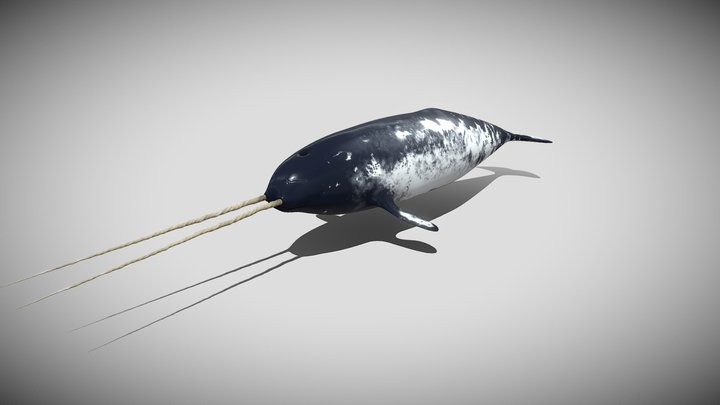
3D model
- Source
- Sketchfab
- Credit
- Cosmic_dust
- Licence
- CC Attribution
- Commercial use
- cannot be read from the licence given — check the record
Smithsonian Open Access was not reached for this taxon, so this list is what the others held rather than everything there is.
The description on this site
- Source
- Wikipedia, “Narwhal”
- Licence
- CC BY-SA 4.0
This is what the site found, which is not the same as what exists.
Keep going
What may have been alongside itMonodontidae through timeThe world it lived on
Occurrence data from the Paleobiology Database, CC BY 4.0. Linnaeus 1758