Ophidiidae
The cusk-eel family, Ophidiidae, is a group of marine bony fishes in the Ophidiiformes order. The scientific name is from the Greek ophis meaning "snake", and refers to their eel-like appearance. True eels diverged from other ray-finned fish during the Jurassic, while cusk-eels are part of the Percomorpha clade, along with tuna, perch, seahorses, and others.

NOAA/ MBARI · Public Domain · via Wikipedia/Commons. May be a photograph of a specimen, or an artist’s reconstruction — an interpretation of a skeleton, since colour and soft tissue are almost never preserved.
On record
Recorded, not inferred- Sits inside
- OphidioideiPBDB
- Diet
- carnivore, parasitePBDB, for Ophidiiformes
- Life habit
- nektobenthicPBDB, for Ophidiiformes
- Motility
- actively mobilePBDB, for Ophidiiformes
Time the record covers
At least 65 million years on record.
The record covers at least 66 Mya to 129 ka. No occurrence read is dated outside 72.2 Mya to 0 Mya.
320 occurrences of Ophidiidae on record, most of them in the Eocene. The Paleobiology Database records this as a living group. Bar height is expected occurrences, not a count: each fossil is spread across the span it is dated to, so a tall narrow bar means tight dating and a low wide one means loose.
When
320 occurrences- Late Cretaceousunder 1%
- Paleocene3%
- Eocene47%
- Oligocene11%
- Miocene23%
- Pliocene6%
- Pleistocene10%
- Holoceneunder 1%
These are dates about fossils, not the animal: the record can only begin after it arose and end before it died out, so either end may reach further. Shares are expected occurrences: a fossil dated to a span is counted partly in each period it straddles. More on what this infers.
Found in
65 formations
- Miretrain Marl Formation20
- Palos Verdes Sand Formation15
- Waihao Greensand Formation13
- Navidad Formation9
- Gatun Formation8
- Selsey Formation · Bracklesham Group8
Loading coastlines…
The named rock units Ophidiidae has been recovered from, largest first. Drawn where the rock is now, not where it formed. 41 further formations hold fewer occurrences each and are not listed. 118 occurrences have no formation on record, which is common for older literature.
Ophidiidae and its relatives
EoceneWhere Ophidiidae and its relatives were recorded in the Eocene.
Found in the same rock
3,527 taxa- Hoplobrotula21 sites
- Bregmaceros20 sites
- Diaphus19 sites
- Apogon17 sites
- Conger17 sites
- Dentex14 sites
- Pterothrissus umbonatus14 sites
- Lesueurigobius13 sites
- Neobythites13 sites
- Pseudophichthys13 sites
- Cepola12 sites
- Deltentosteus12 sites
- Ophidion12 sites
- Paraconger12 sites
- Carcharhinus11 sites
- Cylindracanthus rectus11 sites
- Teleostei11 sites
- Trachinus11 sites
- Clupeidae10 sites
- Diaphus splendidus10 sites
- Gobiidae10 sites
- Gobius10 sites
- Grammonus10 sites
- Haemulon10 sites
The Paleobiology Database records 175 sites for Ophidiidae, and this reads all of them. Of that, one read hit the database's own return limit, so every count below is a floor rather than a total. The number is how many of those sites it was catalogued from too. The 24 sharing the most are listed.
This is not a list of everything alive at the time. It is only what has come out of the same ground as this animal and been written down.
Entered from
81 references- Reconstruction of the fossil marine bony fish fauna (Teleostei) from the Eocene to Pleistocene of New Zealand by means of otoliths. With studies of Recent congroid, morid and trachinoid otoliths46
- Fish otoliths from the Lutetian of the Aquitaine Basin (SW France), a breakthrough in the knowledge of the European Eocene ichthyofauna29
- Fish otoliths from the early Miocene of Chile: a window into the evolution of marine bony fishes in the Southeast Pacific13
- Early Eocene fish otoliths from the eastern and southern USA12
- The otoliths from the middle Eocene of Osteroden near Bramsche, north-western Germany12
- Neue Untersuchungen an tertiaren Fisch-otolithen. Part II12
- The Selsey Division (Bracklesham Group) at Lee-on-the-Solent, Gosport, (Hants)11
- Faunal Horizons of the Barton Beds in Hampshire10
- Fish otoliths from the New Zealand Tertiary9
- Middle and late Eocene fish otoliths from the eastern and southern USA8
- Fish remains, mostly otoliths and teeth, from the Palos Verdes Sand (Late Pleistocene) of California8
- Bathymetric distribution of Miocene to Pleistocene Caribbean teleostean fishes from the coast of Panama and Costa Rica7
Each of the 320 occurrences read was entered from one of these publications, ordered by how many each accounts for. This is not a search for papers mentioning the name. 69 further references are not listed. Entries link to doi.org where the Paleobiology Database holds an identifier, and to its own record where it does not. Relayed as the Paleobiology Database holds them, not checked against what they resolve to.
Media and terms
Media content1
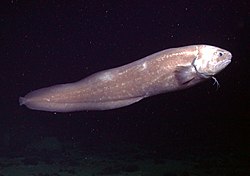
Picture of Ophidiidae
- Source
- Wikipedia/Commons
- Credit
- NOAA/ MBARI
- Licence
- Public Domain
- Commercial use
- the licence allows it
No 3D scan of Ophidiidae was found in Sketchfab.
Smithsonian Open Access and MorphoSource were not reached for this taxon, so this list is what the others held rather than everything there is.
The description on this site
- Source
- Wikipedia, “Cusk-eel”
- Licence
- CC BY-SA 4.0
This is what the site found, which is not the same as what exists.
Keep going
What may have been alongside itOphidioidei through timeFormations of the EoceneThe world it lived on
Occurrence data from the Paleobiology Database, CC BY 4.0. Rafinesque 1810