Oxynoticeras

Uncredited · via Wikidata/Commons. May be a photograph of a specimen, or an artist’s reconstruction — an interpretation of a skeleton, since colour and soft tissue are almost never preserved.
On record
Recorded, not inferred- Sits inside
- OxynoticeratidaePBDB
- Diet
- carnivorePBDB, for Ammonoidea
- Life habit
- nektonicPBDB, for Ammonoidea
- Motility
- fast-movingPBDB, for Ammonoidea
- Vision
- well-developedPBDB, for Cephalopoda
- Environment
- marinePBDB, for Cephalopoda
Time the record covers
At least 55 million years on record.
The record covers at least 192.9 Mya to 137.05 Mya. No occurrence read is dated outside 199.5 Mya to 132.6 Mya.
86 occurrences of Oxynoticeras on record, most of them in the Early Jurassic. Bar height is expected occurrences, not a count: each fossil is spread across the span it is dated to, so a tall narrow bar means tight dating and a low wide one means loose.
When
86 occurrencesThese are dates about fossils, not the animal: the record can only begin after it arose and end before it died out, so either end may reach further. Shares are expected occurrences: a fossil dated to a span is counted partly in each period it straddles. More on what this infers.
Found in
8 formations
- Huayacocotla Formation4
- Isztimér Formation1
- Isztimér Limestone Formation1
- Inklin Formation1
- Lower Lias Formation · Lias Group1
- Adnet Formation1
Loading coastlines…
The named rock units Oxynoticeras has been recovered from, largest first. Drawn where the rock is now, not where it formed. 75 occurrences have no formation on record, which is common for older literature.
Oxynoticeras and its relatives
Early JurassicWhere Oxynoticeras and its relatives were recorded in the Early Jurassic.
Found in the same rock
163 taxa- Belemnitida6 sites
- Oxytoma inequivalvis4 sites
- Rhynchonellida4 sites
- Bifericeras3 sites
- Cheltonia acciptris3 sites
- Cincta numismalis3 sites
- Gastropoda3 sites
- Gleviceras glevense3 sites
- Lucinoidea3 sites
- Lytoceras3 sites
- Pectinida3 sites
- Plagiostoma3 sites
- Zeilleria perforata3 sites
- Actinopterygii2 sites
- Arieticeras algovianum2 sites
- Asteroceras saltriensis2 sites
- Balanocrinus quiaiosensis2 sites
- Bifericeras bifer2 sites
- Bivalvia2 sites
- Crustacea2 sites
- Eparietites glaber2 sites
- Epideroceras steinmanni2 sites
- Geyeroceras cylindricum2 sites
- Gleviceras doris2 sites
The Paleobiology Database records 21 sites for Oxynoticeras, and this reads all of them. The number is how many of those sites it was catalogued from too. The 24 sharing the most are listed.
This is not a list of everything alive at the time. It is only what has come out of the same ground as this animal and been written down.
Entered from
16 references- Ammonites sinémuriennes du Haut-Atlas marocain58
- A temporary exposure of Lower Lias (Late Sinemurian) at Dimmer Camp, Castle Cary, Somerset, south-west England6
- Ammonites from the Lower Jurassic (Sinemurian) of Tenango de Doria (Sierra Madre Oriental, Mexico). Part IV: Biostratigraphy, palaeobiogeography and taxonomic addendum.4
- Les ammonites du Sinémurien et du Pliensbachien inférieur de la montagne du Bakony (Hongrie)3
- Austroalpine Liassic ammonites from Vorarlberg (Austria, Northern Calcareous Alps)3
- The ammonite biostratigraphy of the Lower Lias "Armatum Bed" (Upper Sinemurian-Lower Pliensbachian) at St Peter's Field, Radstock, Somerset2
- Unlocking the secrets of the Early Jurassic of North Africa: first record of pseudoplanktonic crinoid Seirocrinus (Crinoidea, Pentacrinidae) from Morocco and Algeria1
- Carta Los Loros, Región de Atacama, Servicio Nacional de Geología y Minería, Carta Geológica de Chile, Serie Geología Básica, No 92, 53 p, 1 mapa escala 1:100.000, Santiago1
- Early Jurassic Bivalvia of western Canada. Part I. Subclasses Palaeotaxodonta, Pteriomorpha, and Isofilibranchia1
- New Data on Austroalpine Liassic Ammonites from the Adnet Quarries and Adjacent Areas (Oberösterreich, Northern Calcareous Alps)1
- Provenance Constraints on Early Jurassic Evolution of the Northern Stikinian Arc: Laberge Group, Whitehorse Trough, Northwestern British Columbia1
- Zur Ammonitenfauna und Stratigraphie des unteren Lias (Sinemurium bis Carixium) in der Umgebung von Ankara (Türkei)1
Each of the 86 occurrences read was entered from one of these publications, ordered by how many each accounts for. This is not a search for papers mentioning the name. 4 further references are not listed. Entries link to doi.org where the Paleobiology Database holds an identifier, and to its own record where it does not. Relayed as the Paleobiology Database holds them, not checked against what they resolve to.
Media and terms
Media content2
Picture of Oxynoticeras
- Source
- Wikidata/Commons
- Credit
- nobody named on the record
- Licence
- not stated by the source
- Commercial use
- cannot be read from the licence given — check the record
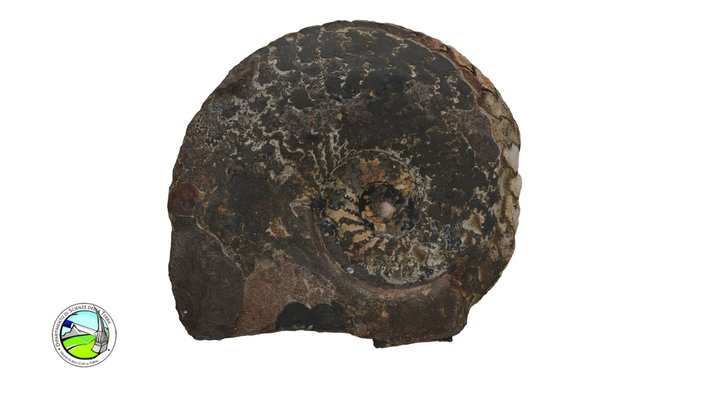
3D model
- Source
- Sketchfab
- Licence
- CC Attribution
- Commercial use
- cannot be read from the licence given — check the record
Smithsonian Open Access and MorphoSource were not reached for this taxon, so this list is what the others held rather than everything there is.
This is what the site found, which is not the same as what exists.
Keep going
What may have been alongside itOxynoticeratidae through timeFormations of the Early JurassicThe world it lived on
Occurrence data from the Paleobiology Database, CC BY 4.0. (Hyatt 1874)