Paracidaris

Uncredited · via Wikidata/Commons. May be a photograph of a specimen, or an artist’s reconstruction — an interpretation of a skeleton, since colour and soft tissue are almost never preserved.
On record
Recorded, not inferred- Sits inside
- PolycidaridaePBDB
- Diet
- grazer, omnivorePBDB, for Cidaroida
- Life habit
- low-level epifaunalPBDB, for Cidaroida
- Motility
- slow-movingPBDB, for Cidaroida
- Vision
- limitedPBDB, for Echinoidea
- Environment
- marinePBDB, for Cidaroida
Time the record covers
At least 57 million years on record.
The record covers at least 170.9 Mya to 113.2 Mya. No occurrence read is dated outside 174.7 Mya to 100.5 Mya.
110 occurrences of Paracidaris on record, most of them in the Late Jurassic. Bar height is expected occurrences, not a count: each fossil is spread across the span it is dated to, so a tall narrow bar means tight dating and a low wide one means loose.
When
110 occurrences- Middle Jurassic18%
- Late Jurassic81%
- Early Cretaceousunder 1%
These are dates about fossils, not the animal: the record can only begin after it arose and end before it died out, so either end may reach further. Shares are expected occurrences: a fossil dated to a span is counted partly in each period it straddles. More on what this infers.
Found in
24 formations
- Coralline Oolite Formation20
- Bärschwil Formation20
- St-Ursanne Formation10
- Wildegg Formation8
- Birdlip Limestone Formation · Inferior Oolite Group4
- West Walton Formation2
Loading coastlines…
The named rock units Paracidaris has been recovered from, largest first. Drawn where the rock is now, not where it formed. 21 occurrences have no formation on record, which is common for older literature.
Paracidaris and its relatives
Late JurassicWhere Paracidaris and its relatives were recorded in the Late Jurassic.
Found in the same rock
481 taxa- Anisocidaris smithii11 sites
- Isastrea10 sites
- Plegiocidaris crucifera10 sites
- Chlamys9 sites
- Plagiostoma8 sites
- Thamnasteria8 sites
- Thecosmilia8 sites
- Isocrinus7 sites
- Lopha7 sites
- Montlivaltia7 sites
- Ctenostreon6 sites
- Liostrea6 sites
- Rhabdocidaris6 sites
- Serpula6 sites
- Belemnitida5 sites
- Diplocidaris gigantea5 sites
- Modiolus5 sites
- Nubecularia5 sites
- Pentacrinites5 sites
- Stylosmilia5 sites
- Anisocidaris bajociensis4 sites
- Barbatia4 sites
- Bourguetia4 sites
- Camptonectes4 sites
The Paleobiology Database records 94 sites for Paracidaris, and this reads all of them. The number is how many of those sites it was catalogued from too. The 24 sharing the most are listed.
This is not a list of everything alive at the time. It is only what has come out of the same ground as this animal and been written down.
Entered from
21 references- British Jurassic regular echinoids. Part 1, Introduction, Cidaroida, Echinothurioida, Aspidodiadematoida and Pedinoida40
- Die Cidaroiden (Echinoidea, Echinodermata) des Sornetan-und des Liesberg-Members der Bärschwil-Formation (mittleres Oxfordien, Nordwestschweizer Jura)20
- The cidaroids from the Middle Oxfordian St-Ursanne Formation of the Swiss Jura Mountains10
- Die Cidariden (Echinoidea, Echinodermata) der Wildegg-Formation (mittleres Oxfordien, Schweizer Jura)8
- Echiniden aus dem Nusplinger Plattenkalk (Ober-Kimmeridgium, Südwestdeutschland)4
- Facies and palaeoecology of Upper Jurassic (Middle Oxfordian) coral reefs in England4
- Bioconstructions bajociennes à madréporaires et faciès associés dans l'Ile Crémieu (Jura du Sud; France)4
- Unpublished data3
- Im Reich der Meerengel. Der Nusplinger Plattenkalk und seine Fossilien2
- Les echinides fossiles de l'Oxfordien de Foug2
- Lower Kimmeridgian echinoids of Poland2
- Korallenfaunen aus dem Oberen Jura von Portugal2
Each of the 110 occurrences read was entered from one of these publications, ordered by how many each accounts for. This is not a search for papers mentioning the name. 9 further references are not listed. Entries link to doi.org where the Paleobiology Database holds an identifier, and to its own record where it does not. Relayed as the Paleobiology Database holds them, not checked against what they resolve to.
Media and terms
Media content2
Picture of Paracidaris
- Source
- Wikidata/Commons
- Credit
- nobody named on the record
- Licence
- not stated by the source
- Commercial use
- cannot be read from the licence given — check the record
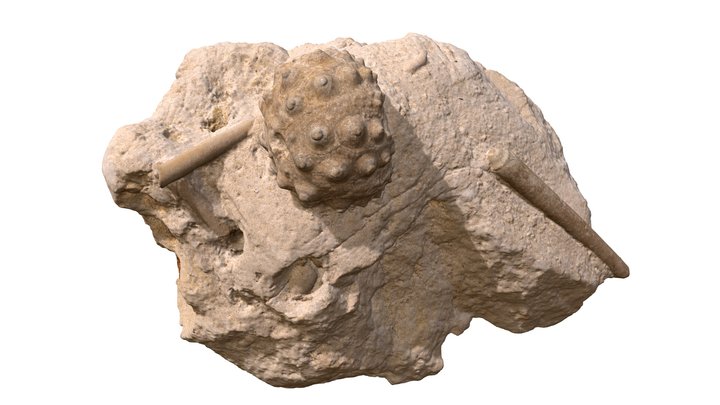
3D model
- Source
- Sketchfab
- Licence
- CC Attribution
- Commercial use
- cannot be read from the licence given — check the record
Smithsonian Open Access and MorphoSource were not reached for this taxon, so this list is what the others held rather than everything there is.
This is what the site found, which is not the same as what exists.
Keep going
What may have been alongside itPolycidaridae through timeFormations of the Late JurassicThe world it lived on
Occurrence data from the Paleobiology Database, CC BY 4.0.