Physeter
Searched as Physeter macrocephalus catodon. The Paleobiology Database treats Physeter as the accepted name.
Physeter is a genus of toothed whales. There is only one living species in this genus: the sperm whale. Some extremely poorly known fossil species have also been assigned to the same genus including Physeter antiquus from the Pliocene of France, and Physeter vetus from the Quaternary of the U.S. state of Georgia. Physeter vetus is very likely an invalid species, as the few teeth that were used to identify this species appear to be identical to those of another toothed whale, Orycterocetus quadratidens.

Gabriel Barathieu · CC BY-SA 2.0 · via Wikidata/Commons. May be a photograph of a specimen, or an artist’s reconstruction — an interpretation of a skeleton, since colour and soft tissue are almost never preserved.
On record
Recorded, not inferred- Sits inside
- PhyseteridaePBDB
- Diet
- carnivorePBDB
- Life habit
- aquatic, depth=surfacePBDB
- Motility
- actively mobilePBDB
- Environment
- oceanicPBDB
Time the record covers
At most 118 thousand years on record.
The one occurrence read is dated to somewhere between 129 ka and 11.7 ka, which is a dating window rather than a span.
1 occurrence of Physeter on record, most of them in the Pleistocene. The Paleobiology Database records this as a living group. Bar height is expected occurrences, not a count: each fossil is spread across the span it is dated to, so a tall narrow bar means tight dating and a low wide one means loose.
When
1 occurrences- Pleistocene100%
These are dates about fossils, not the animal: the record can only begin after it arose and end before it died out, so either end may reach further. Shares are expected occurrences: a fossil dated to a span is counted partly in each period it straddles. More on what this infers.
Physeter and its relatives
PleistoceneWhere Physeter and its relatives were recorded in the Pleistocene.
Found in the same rock
724 taxa- Delphinidae7 sites
- Mysticeti7 sites
- Otodus megalodon7 sites
- Balaena6 sites
- Balaenopteridae6 sites
- Carcharodon hastalis6 sites
- Ziphiidae6 sites
- Carcharodon carcharias5 sites
- Mesoplodon5 sites
- Ontocetus emmonsi5 sites
- Phocidae5 sites
- Balaenidae4 sites
- Balaenoptera4 sites
- Balaenoptera musculus4 sites
- Isurus oxyrinchus4 sites
- Odontoceti4 sites
- Orcinus orca4 sites
- Physeteridae4 sites
- Sus scrofa4 sites
- Tursiops4 sites
- Acipenser3 sites
- Balaenoptera physalus3 sites
- Carcharias taurus3 sites
- Cetacea3 sites
The Paleobiology Database records 73 sites for Physeter, and this reads all of them. The number is how many of those sites it was catalogued from too. The 24 sharing the most are listed.
This is not a list of everything alive at the time. It is only what has come out of the same ground as this animal and been written down.
Entered from
1 referenceEach of the 1 occurrence read was entered from one of these publications, ordered by how many each accounts for. This is not a search for papers mentioning the name. Each entry links to doi.org. Relayed as the Paleobiology Database holds them, not checked against what they resolve to.
Media and terms
Media content2
Picture of Physeter
- Source
- Wikidata/Commons
- Credit
- Gabriel Barathieu
- Licence
- CC BY-SA 2.0
- Commercial use
- the licence allows it
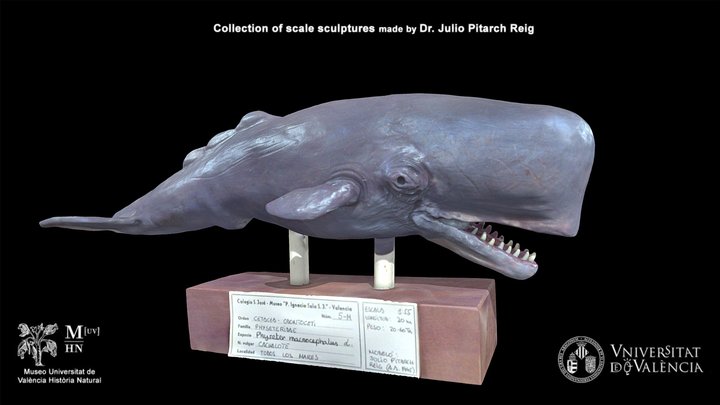
3D model
- Source
- Sketchfab
- Licence
- CC Attribution
- Commercial use
- cannot be read from the licence given — check the record
Smithsonian Open Access and MorphoSource were not reached for this taxon, so this list is what the others held rather than everything there is.
The description on this site
- Source
- Wikipedia, “Physeter”
- Licence
- CC BY-SA 4.0
This is what the site found, which is not the same as what exists.
Keep going
What may have been alongside itPhyseteridae through timeFormations of the PleistoceneThe world it lived on
Occurrence data from the Paleobiology Database, CC BY 4.0. Linnaeus 1758