Sardinops
Sardinops is a genus of sardines of the family Alosidae. It is found in the Indo-Pacific, East Pacific, Southeastern Atlantic, and southwestern Indian oceans. Its length is up to 40 cm (16 in). It has numerous common or vernacular names, some of which more appropriately refer to subspecies, including blue pilchard, blue-bait, South American pilchard, Chilean sardine, and Pacific sardine.

harum.koh from Kobe city, Japan · CC BY-SA 2.0 · via Wikipedia/Commons. May be a photograph of a specimen, or an artist’s reconstruction — an interpretation of a skeleton, since colour and soft tissue are almost never preserved.
On record
Recorded, not inferred- Sits inside
- ClupeidaePBDB
- Diet
- carnivorePBDB, for Clupeiformes
- Life habit
- nektonicPBDB, for Clupeiformes
- Motility
- actively mobilePBDB, for Clupeiformes
Time the record covers
At least 37 million years on record.
The record covers at least 37.71 Mya to 11.7 ka. No occurrence read is dated outside 56 Mya to 0 Mya.
27 occurrences of Sardinops on record, most of them in the Miocene. The Paleobiology Database records this as a living group. Bar height is expected occurrences, not a count: each fossil is spread across the span it is dated to, so a tall narrow bar means tight dating and a low wide one means loose.
When
27 occurrencesThese are dates about fossils, not the animal: the record can only begin after it arose and end before it died out, so either end may reach further. Shares are expected occurrences: a fossil dated to a span is counted partly in each period it straddles. More on what this infers.
Found in
12 formations
- Pisco Formation4
- Bahía Inglesa Formation4
- Otuma Formation1
- Wilson Grove Formation1
- Palos Verdes Sand Formation1
- Chatton Formation1
Loading coastlines…
The named rock units Sardinops has been recovered from, largest first. Drawn where the rock is now, not where it formed. 9 occurrences have no formation on record, which is common for older literature.
Sardinops and its relatives
MioceneWhere Sardinops and its relatives were recorded in the Miocene.
Found in the same rock
565 taxa- Gobius7 sites
- Conger6 sites
- Engraulis japonicus4 sites
- Labridae4 sites
- Carcharhinus3 sites
- Carcharhinus brachyurus3 sites
- Cepola3 sites
- Ceratoscopelus3 sites
- Citharus3 sites
- Dentex3 sites
- Genypterus3 sites
- Gobius copiosus3 sites
- Gobius urbanus3 sites
- Isurus oxyrinchus3 sites
- Maurolicus muelleri3 sites
- Myliobatis californica3 sites
- Pristigenys3 sites
- Pseudophichthys3 sites
- Pterothrissus umbonatus3 sites
- Raja3 sites
- Sebastes3 sites
- Sillago3 sites
- Trachurus3 sites
- Acrophoca2 sites
The Paleobiology Database records 26 sites for Sardinops, and this reads all of them. The number is how many of those sites it was catalogued from too. The 24 sharing the most are listed.
This is not a list of everything alive at the time. It is only what has come out of the same ground as this animal and been written down.
Entered from
19 references- 541. Some Pleistocene fish-otoliths from the Boso and Miura peninsulas5
- What do we know about Neogene bony fishes from Chile? Diversity and biogeographic implications3
- Neogene bony fishes from the Bahia Inglesa Formation, northern Chile2
- Otolithes de poissons du paléocanyon de saubrigues (chattien à langhien), aquitaine méridionale, France2
- Fish otolith record reveals possible tropical-subtropical fish community in temperate Japan during the exceptionally warm Last Interglacial period1
- Middle and late Eocene fish otoliths from the eastern and southern USA1
- Fossil fish otoliths from the Chibanian Miyata Formation, Kanagawa Prefecture, Japan, with comments on the paleoenvironment1
- Reconstruction of the fossil marine bony fish fauna (Teleostei) from the Eocene to Pleistocene of New Zealand by means of otoliths. With studies of Recent congroid, morid and trachinoid otoliths1
- Did the giant extinct shark Carcharocles megalodon target small prey? Bite marks on marine mammal remains from the late Miocene of Peru1
- Otoliths reveal diverse fish communities in Late Oligocene estuarine to deep-water paleoenvironments in southern Zealandia1
- A new marine vertebrate assemblage from the Wilson Grove Formation at Bloomfield Quarry (Late Miocene), Sonoma County, California1
- Distribution of fossil marine vertebrates in Cerro Colorado, the type locality of the giant raptorial sperm whale Livyatan melvillei (Miocene, Pisco Formation, Peru)1
Each of the 27 occurrences read was entered from one of these publications, ordered by how many each accounts for. This is not a search for papers mentioning the name. 7 further references are not listed. Entries link to doi.org where the Paleobiology Database holds an identifier, and to its own record where it does not. Relayed as the Paleobiology Database holds them, not checked against what they resolve to.
Media and terms
Media content3

Picture of Sardinops
- Source
- Wikipedia/Commons
- Credit
- harum.koh from Kobe city, Japan
- Licence
- CC BY-SA 2.0
- Commercial use
- the licence allows it
CT scan
- Source
- MorphoSource
- Licence
- In Copyright
- Commercial use
- cannot be read from the licence given — check the record
- Specimen
- Sardinops caerulea · UWFC:ADULT COLLECTION:UW 004853
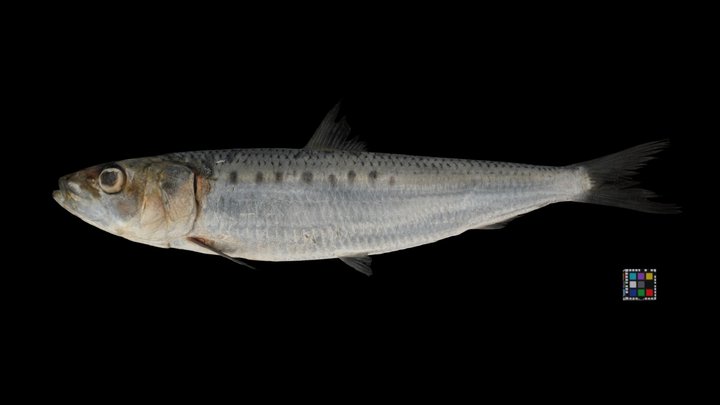
3D model
- Source
- Sketchfab
- Licence
- CC0 Public Domain
- Commercial use
- the licence allows it
The description on this site
- Source
- Wikipedia, “Sardinops”
- Licence
- CC BY-SA 4.0
This is what the site found, which is not the same as what exists.
Keep going
What may have been alongside itClupeidae through timeFormations of the MioceneThe world it lived on
Occurrence data from the Paleobiology Database, CC BY 4.0. Hubbs 1929