Cephaloscyllium
Cephaloscyllium is a genus of catsharks, and part of the family Scyliorhinidae, commonly known as swellsharks because of their ability to inflate their bodies with water or air as a defense against predators. These sluggish, bottom-dwelling sharks are found widely in the tropical and temperate coastal waters of the Indian and Pacific Oceans. They have stocky, spindle-shaped bodies and short, broad, and flattened heads. The mouth is capacious, containing many small teeth and lacking furrows at the corners. The two dorsal fins are placed far back on the body, with the first much larger than the second. Different species have various color patterns of saddles, blotches, reticulations, and/or spots. The largest members of the genus can grow over 1 m (3.3 ft) in length. Swellsharks prey on a variety of fishes and invertebrates, and are oviparous, with females producing egg capsules in pairs. They are harmless and have been deemed of having no commercial value.

Nick Long · CC BY-SA 2.0 · via Wikipedia/Commons. May be a photograph of a specimen, or an artist’s reconstruction — an interpretation of a skeleton, since colour and soft tissue are almost never preserved.
On record
Recorded, not inferred- Sits inside
- ScyliorhinidaePBDB
- Diet
- carnivorePBDB, for Carcharhiniformes
- Life habit
- nektonicPBDB, for Carcharhiniformes
- Motility
- actively mobilePBDB, for Carcharhiniformes
Time the record covers
At least 20 million years on record.
The record covers at least 20.45 Mya to 11.7 ka. No occurrence read is dated outside 23.04 Mya to 0 Mya.
4 occurrences of Cephaloscyllium on record, most of them in the Miocene. The Paleobiology Database records this as a living group. Bar height is expected occurrences, not a count: each fossil is spread across the span it is dated to, so a tall narrow bar means tight dating and a low wide one means loose.
When
4 occurrencesThese are dates about fossils, not the animal: the record can only begin after it arose and end before it died out, so either end may reach further. Shares are expected occurrences: a fossil dated to a span is counted partly in each period it straddles. More on what this infers.
Found in
3 formations
- Jewett Formation1
- Temblor Formation1
- Makino Formation · Awa Group1
Loading coastlines…
The named rock units Cephaloscyllium has been recovered from, largest first. Drawn where the rock is now, not where it formed. 1 occurrence has no formation on record, which is common for older literature.
Cephaloscyllium and its relatives
MioceneWhere Cephaloscyllium and its relatives were recorded in the Miocene.
Found in the same rock
172 taxa- Alopias vulpinus2 sites
- Carcharhinus2 sites
- Carcharodon carcharias2 sites
- Carcharodon hastalis2 sites
- Cetorhinus2 sites
- Echinorhinus blakei2 sites
- Embiotocidae2 sites
- Heterodontus2 sites
- Hexanchus2 sites
- Isurus2 sites
- Megasqualus occidentalis2 sites
- Myliobatis californica2 sites
- Negaprion2 sites
- Raja2 sites
- Sphyrna2 sites
- Squatina lerichei2 sites
- Allodesmus kernensis1 site
- Allodesmus sinanoensis1 site
- Alopias exigua1 site
- Alopias latidens1 site
- Amiantis mathewsoni1 site
- Amphistichus argenteus1 site
- Anadara montereyana1 site
- Anatidae1 site
The Paleobiology Database records 4 sites for Cephaloscyllium, and this reads all of them. The number is how many of those sites it was catalogued from too. The 24 sharing the most are listed.
This is not a list of everything alive at the time. It is only what has come out of the same ground as this animal and been written down.
Entered from
4 references- Deep-sea elasmobranchs from the late early to middle Miocene (Burdigalian-Langhian) Makino Formation (Awa Group), Japan1
- Otoliths and other fish remains from the Chumash Midden at Rincon Point (SBa-1) Santa Barbara-Ventura counties, California1
- The Enaliarctinae: A new group of extinct aquatic carnivora and a consideration of the origin of the otariidae1
- History of research at Sharktooth Hill, Kern County, California1
Each of the 4 occurrences read was entered from one of these publications, ordered by how many each accounts for. This is not a search for papers mentioning the name. Entries link to doi.org where the Paleobiology Database holds an identifier, and to its own record where it does not. Relayed as the Paleobiology Database holds them, not checked against what they resolve to.
Media and terms
Media content2
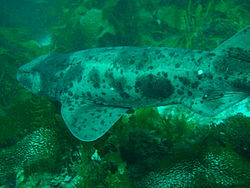
Picture of Cephaloscyllium
- Source
- Wikipedia/Commons
- Credit
- Nick Long
- Licence
- CC BY-SA 2.0
- Commercial use
- the licence allows it
CT scan
- Source
- MorphoSource
- Licence
- In Copyright
- Commercial use
- cannot be read from the licence given — check the record
- Specimen
- Cephaloscyllium sarawakensis · CSIRO:ANFC:H6230-01
Smithsonian Open Access was not reached for this taxon, so this list is what the others held rather than everything there is.
The description on this site
- Licence
- CC BY-SA 4.0
This is what the site found, which is not the same as what exists.
Keep going
What may have been alongside itScyliorhinidae through timeFormations of the MioceneThe world it lived on
Occurrence data from the Paleobiology Database, CC BY 4.0. Gill 1861