Kogiidae
Kogiidae is a family comprising at least two extant species of Cetacea, the pygmy and dwarf sperm whales. As their common names suggest, they somewhat resemble sperm whales, with squared heads and small lower jaws, but are much smaller, with much shorter skulls and more notable dorsal fins than sperm whales. Kogiids are also characterized by a "false gill slit" behind their eyes.

This illustration was made by Citron You must credit this : Citron / CC-BY-SA-3.0 · CC BY-SA 3.0 · via Wikipedia/Commons. May be a photograph of a specimen, or an artist’s reconstruction — an interpretation of a skeleton, since colour and soft tissue are almost never preserved.
On record
Recorded, not inferred- Also called
- pygmy sperm whalePBDB
- Sits inside
- PhyseteroideaPBDB
- Diet
- carnivorePBDB, for Odontoceti
- Life habit
- aquatic, depth=surfacePBDB, for Cetacea
- Motility
- actively mobilePBDB, for Cetacea
- Environment
- marine,freshwaterPBDB, for Odontoceti
Time the record covers
At least 13 million years on record.
The record covers at least 13.82 Mya to 11.7 ka. No occurrence read is dated outside 23.04 Mya to 0 Mya.
66 occurrences of Kogiidae on record, most of them in the Miocene. The Paleobiology Database records this as a living group. Bar height is expected occurrences, not a count: each fossil is spread across the span it is dated to, so a tall narrow bar means tight dating and a low wide one means loose.
When
66 occurrences- Miocene37%
- Pliocene30%
- Pleistocene2%
- Holocene32%
These are dates about fossils, not the animal: the record can only begin after it arose and end before it died out, so either end may reach further. Shares are expected occurrences: a fossil dated to a span is counted partly in each period it straddles. More on what this infers.
Found in
16 formations
- Pisco Formation8
- Yorktown Formation · Chesapeake Group7
- Peace River Formation · Hawthorn Group4
- Almejas Formation2
- Tirabuzon Formation2
- Bahía Inglesa Formation2
Loading coastlines…
The named rock units Kogiidae has been recovered from, largest first. Drawn where the rock is now, not where it formed. 30 occurrences have no formation on record, which is common for older literature.
Kogiidae and its relatives
MioceneWhere Kogiidae and its relatives were recorded in the Miocene.
Found in the same rock
812 taxa- Kogia breviceps18 sites
- Otodus megalodon10 sites
- Phocidae9 sites
- Balaenopteridae8 sites
- Delphinidae7 sites
- Kogia7 sites
- Myliobatis7 sites
- Ontocetus emmonsi7 sites
- Ziphiidae7 sites
- Carcharodon hastalis6 sites
- Monachinae6 sites
- Mysticeti6 sites
- Physeteridae6 sites
- Carcharodon carcharias5 sites
- Delphinus5 sites
- Kogia sima5 sites
- Mesoplodon5 sites
- Ninoziphius platyrostris5 sites
- Odontoceti5 sites
- Phalacrocorax5 sites
- Phocoenidae5 sites
- Scaldicetus5 sites
- Spheniscidae5 sites
- Alosidae4 sites
The Paleobiology Database records 52 sites for Kogiidae, and this reads all of them. The number is how many of those sites it was catalogued from too. The 24 sharing the most are listed.
This is not a list of everything alive at the time. It is only what has come out of the same ground as this animal and been written down.
Entered from
36 references- Preliminary estimates of the abundance of cetaceans along the U.S. west coast: 1991-200110
- Pygmy sperm whales (Odontoceti, Kogiidae) from the Pliocene of Florida and North Carolina8
- Marine mammal strandings in the New Caledonia region, Southwest Pacific8
- Neogene Cetacea of the Lee Creek Phosphate Mine, North Carolina3
- A new physeteroid from the late Miocene of Peru expands the diversity of extinct dwarf and pygmy sperm whales (Cetacea: Odontoceti: Kogiidae)2
- Evolutionary patterns among living and fossil kogiid sperm whales: Evidence from the Neogene of Central America2
- A list of fossil cetaceans in Japan2
- Pygmy sperm whales (Kogia) in the Italian Pliocene2
- Catalog of Living Whales2
- Bridging two oceans: small toothed cetaceans (Odontoceti) from the Late Miocene Chagres Formation, eastern Caribbean (Colon, Panama)1
- Estado actual del conocimiento de los mamíferos fósiles de Chile1
- Fossil Pinnipedia and Cetacea1
Each of the 66 occurrences read was entered from one of these publications, ordered by how many each accounts for. This is not a search for papers mentioning the name. 24 further references are not listed. Entries link to doi.org where the Paleobiology Database holds an identifier, and to its own record where it does not. Relayed as the Paleobiology Database holds them, not checked against what they resolve to.
Media and terms
Media content1
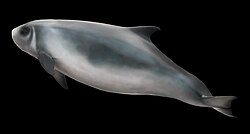
Picture of Kogiidae
- Source
- Wikipedia/Commons
- Credit
- This illustration was made by Citron You must credit this : Citron / CC-BY-SA-3.0
- Licence
- CC BY-SA 3.0
- Commercial use
- the licence allows it
No 3D scan of Kogiidae was found in Sketchfab.
Smithsonian Open Access and MorphoSource were not reached for this taxon, so this list is what the others held rather than everything there is.
The description on this site
- Source
- Wikipedia, “Kogiidae”
- Licence
- CC BY-SA 4.0
This is what the site found, which is not the same as what exists.
Keep going
What may have been alongside itPhyseteroidea through timeFormations of the MioceneThe world it lived on
Occurrence data from the Paleobiology Database, CC BY 4.0. Miller 1923