Lymnaeidae
Lymnaeidae, common name the pond snails, is a taxonomic family of small to large air-breathing freshwater snails, aquatic pulmonate gastropod mollusks, that belong to the clade Hygrophila.

Dr. Lars Peters · CC BY-SA 3.0 · via Wikipedia/Commons. May be a photograph of a specimen, or an artist’s reconstruction — an interpretation of a skeleton, since colour and soft tissue are almost never preserved.
On record
Recorded, not inferred- Sits inside
- LymnaeoideaPBDB
- Life habit
- epifaunalPBDB, for Gastropoda
- Motility
- actively mobilePBDB, for Gastropoda
- Vision
- limitedPBDB, for Gastropoda
- Environment
- freshwaterPBDB
Time the record covers
At least 168 million years on record.
The record covers at least 168.2 Mya to 11.7 ka. No occurrence read is dated outside 170.9 Mya to 0 Mya.
258 occurrences of Lymnaeidae on record, most of them in the Miocene. The Paleobiology Database records this as a living group. Bar height is expected occurrences, not a count: each fossil is spread across the span it is dated to, so a tall narrow bar means tight dating and a low wide one means loose.
When
258 occurrences- Middle Jurassic2%
- Late Jurassicunder 1%
- Late Cretaceous3%
- Paleoceneunder 1%
- Eocene10%
- Oligocene4%
- Miocene45%
- Pliocene7%
- Pleistocene27%
- Holocene2%
These are dates about fossils, not the animal: the record can only begin after it arose and end before it died out, so either end may reach further. Shares are expected occurrences: a fossil dated to a span is counted partly in each period it straddles. More on what this infers.
Found in
46 formations
- Ober Süßwassermolasse Formation13
- Kirchberg Formation11
- Upper Freshwater Molasse Formation · Molasse Group9
- Wind River Formation6
- Borgloon Formation · Tongeren Group5
- Headon Beds Formation4
Loading coastlines…
The named rock units Lymnaeidae has been recovered from, largest first. Drawn where the rock is now, not where it formed. 22 further formations hold fewer occurrences each and are not listed. 141 occurrences have no formation on record, which is common for older literature.
Lymnaeidae and its relatives
MioceneWhere Lymnaeidae and its relatives were recorded in the Miocene.
Found in the same rock
3,133 taxa- Lymnaea47 sites
- Gyraulus27 sites
- Vertigo21 sites
- Lymnaea dilatata20 sites
- Planorbarius cornu19 sites
- Pisidium18 sites
- Sphaerium18 sites
- Pseudochloritis incrassata16 sites
- Succinea15 sites
- Fossarulus moniliferus14 sites
- Physa14 sites
- Planorbis14 sites
- Stagnicola14 sites
- Gyraulus pulici13 sites
- Helicidae13 sites
- Radix korlevici13 sites
- Limax12 sites
- Palaeotachea silvana12 sites
- Radix12 sites
- Bithynia11 sites
- Fossaria11 sites
- Galba dupuyiana11 sites
- Anisus10 sites
- Bania valvatoides10 sites
The Paleobiology Database records 157 sites for Lymnaeidae, and this reads all of them. The number is how many of those sites it was catalogued from too. The 24 sharing the most are listed.
This is not a list of everything alive at the time. It is only what has come out of the same ground as this animal and been written down.
Entered from
97 references- Early Miocene continental gastropods from new localities of the Molasse Basin in southern Germany25
- The fossil pulmonate snails of Sandelzhausen (Early/Middle Miocene, Germany) (Hygrophila, Punctoidea and limacoids)15
- The Middle Miocene freshwater mollusk fauna of Lake Gacko (SE Bosnia and Herzegovina): taxonomic revision and paleoenvironmental analysis14
- The fossil continental mollusks in the upper freshwater molasse (Middle Miocene) of the districts of Biberach, Ravensburg and Neu-Ulm, Germany10
- Moluscos continentales del Plio-Pleistoceno de la cuenca de Guadix-Baza7
- Pliocene non-marine mollusks from Contra Costa County, California7
- A Late Pleistocene fauna and flora from Upton Warren, Worcestershire7
- Middle Miocene freshwater mollusks from Lake Sinj (Dinaride lake system, SE Croatia; Langhian)6
- Non-marine Mollusca6
- Eocene fresh-water Mollusca from Wyoming6
- The molluscan fauna of the Borgloon Formation in Belgium (Rupelian, Early Oligocene)5
- A diverse late-glacial (Mackinaw Phase) biota from Leamington, Ontario5
Each of the 258 occurrences read was entered from one of these publications, ordered by how many each accounts for. This is not a search for papers mentioning the name. 85 further references are not listed. Entries link to doi.org where the Paleobiology Database holds an identifier, and to its own record where it does not. Relayed as the Paleobiology Database holds them, not checked against what they resolve to.
Media and terms
Media content1
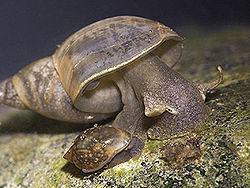
Picture of Lymnaeidae
- Source
- Wikipedia/Commons
- Credit
- Dr. Lars Peters
- Licence
- CC BY-SA 3.0
- Commercial use
- the licence allows it
No 3D scan was found. Smithsonian Open Access, MorphoSource and Sketchfab were all searched.
The description on this site
- Source
- Wikipedia, “Lymnaeidae”
- Licence
- CC BY-SA 4.0
This is what the site found, which is not the same as what exists.
Keep going
What may have been alongside itLymnaeoidea through timeFormations of the MioceneThe world it lived on
Occurrence data from the Paleobiology Database, CC BY 4.0. Rafinesque 1815