Physa
Physa is a genus of small, left-handed or sinistral, air-breathing freshwater snails, aquatic pulmonate gastropod molluscs in the subfamily Physinae of the family Physidae.

Francisco Welter Schultes · Public Domain · via Wikipedia/Commons. May be a photograph of a specimen, or an artist’s reconstruction — an interpretation of a skeleton, since colour and soft tissue are almost never preserved.
On record
Recorded, not inferred- Sits inside
- PhysiniPBDB
- Life habit
- epifaunalPBDB, for Gastropoda
- Motility
- actively mobilePBDB, for Gastropoda
- Vision
- limitedPBDB, for Gastropoda
- Environment
- freshwaterPBDB, for Physidae
Time the record covers
At least 139 million years on record.
The record covers at least 139.1 Mya to 11.7 ka. No occurrence read is dated outside 143.1 Mya to 0 Mya.
92 occurrences of Physa on record, most of them in the Late Cretaceous. The Paleobiology Database records this as a living group. Bar height is expected occurrences, not a count: each fossil is spread across the span it is dated to, so a tall narrow bar means tight dating and a low wide one means loose.
When
92 occurrencesThese are dates about fossils, not the animal: the record can only begin after it arose and end before it died out, so either end may reach further. Shares are expected occurrences: a fossil dated to a span is counted partly in each period it straddles. More on what this infers.
Found in
41 formations
- Lameta Formation7
- Mankuanhe Formation4
- Queguay Formation4
- North Horn Formation3
- Fort Crittenden Formation3
- Caloosahatchee Formation3
Loading coastlines…
The named rock units Physa has been recovered from, largest first. Drawn where the rock is now, not where it formed. 17 further formations hold fewer occurrences each and are not listed. 22 occurrences have no formation on record, which is common for older literature.
Physa and its relatives
Late CretaceousWhere Physa and its relatives were recorded in the Late Cretaceous.
Found in the same rock
2,206 taxa- Viviparus14 sites
- Unio11 sites
- Lepisosteus10 sites
- Testudines10 sites
- Gyraulus9 sites
- Helisoma9 sites
- Lymnaea9 sites
- Trionychidae9 sites
- Gastropoda8 sites
- Lioplacodes8 sites
- Sphaerium8 sites
- Anura7 sites
- Dinosauria7 sites
- Valvata7 sites
- Helisoma trivolvis6 sites
- Turritella6 sites
- Caryocorbula5 sites
- Chione cancellata5 sites
- Compsemys victa5 sites
- Dromaeosauridae5 sites
- Elopidae5 sites
- Gastrocopta5 sites
- Gastrocopta armifera5 sites
- Hadrosauridae5 sites
The Paleobiology Database records 84 sites for Physa, and this reads all of them. The number is how many of those sites it was catalogued from too. The 24 sharing the most are listed.
This is not a list of everything alive at the time. It is only what has come out of the same ground as this animal and been written down.
Entered from
60 references- Continental Late Cretaceous gastropod assemblages from Uruguay. Paleoecology, age, and the oldest record of two families and a genus4
- Pliocene Molluscs and Fishes from Northeastern California and Northwestern Nevada4
- Mesozoic and Cenozoic fossil Gastropoda from Yunnan4
- Eocene fresh-water Mollusca from Wyoming4
- Occurence of dinosaurian remains from the Lameta beds of Umrer, Nagpur district, Maharashtra3
- Fossil vertebrates from the Late Cretaceous Lance Formation, eastern Wyoming3
- Cretaceous dinosaurian remains from southern Arizona3
- Neogene Biostratigraphy of the Charlotte Harbor Area in Southwestern Florida3
- Late Pleistocene invertebrates of the Newport Bay area, California3
- Tremarctotherium from the Pleistocene of Meade County, Kansas3
- Eocene Nonmarine Gastropods from Hot Spring County, Wyoming3
- La Neuve, gisement à plantes, invertébrés et vertébrés du Bégudien (Sénonien supérieur continental) du bassin d'Aix-en-Provence [La Neuve, Aix-en-Provence Basin, SE France, a new fossil site bearing plants, invertebrates and vertebrates of Begudian age (continental Late Senonian)]2
Each of the 92 occurrences read was entered from one of these publications, ordered by how many each accounts for. This is not a search for papers mentioning the name. 48 further references are not listed. Entries link to doi.org where the Paleobiology Database holds an identifier, and to its own record where it does not. Relayed as the Paleobiology Database holds them, not checked against what they resolve to.
Media and terms
Media content1
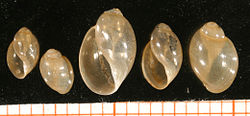
Picture of Physa
- Source
- Wikipedia/Commons
- Credit
- Francisco Welter Schultes
- Licence
- Public Domain
- Commercial use
- the licence allows it
No 3D scan was found. Smithsonian Open Access, MorphoSource and Sketchfab were all searched.
The description on this site
- Source
- Wikipedia, “Physa”
- Licence
- CC BY-SA 4.0
This is what the site found, which is not the same as what exists.
Keep going
What may have been alongside itPhysini through timeFormations of the Late CretaceousThe world it lived on
Occurrence data from the Paleobiology Database, CC BY 4.0. Draparnaud 1801