Praemegaceros verticornis
No picture of Praemegaceros verticornis was found. Wikidata and iDigBio were searched and had none. Wikipedia has a picture filed under this name, but nothing tied it to Praemegaceros verticornis itself, so it was not used. Smithsonian Open Access did not answer, so this is what the others held rather than everything there is. GBIF was asked, and what came back is not recorded: nothing, or a picture this site could not tie to Praemegaceros verticornis, or no answer at all. This entry cannot say which.
On record
Recorded, not inferred- Sits inside
- PraemegacerosPBDB
- Diet
- grazer, browserPBDB, for Cervidae
- Life habit
- ground dwellingPBDB, for Cervidae
- Motility
- actively mobilePBDB, for Osteichthyes
- Environment
- terrestrialPBDB, for Artiodactyla
Time the record covers
At most 2.6 million years on record.
Every occurrence read is dated to somewhere between 2.58 Mya and 11.7 ka, and nothing in the dating separates them, so that window is what the record shows rather than a span.
23 occurrences of Praemegaceros verticornis on record, most of them in the Pleistocene. Bar height is expected occurrences, not a count: each fossil is spread across the span it is dated to, so a tall narrow bar means tight dating and a low wide one means loose.
When
23 occurrences- Pleistocene100%
These are dates about fossils, not the animal: the record can only begin after it arose and end before it died out, so either end may reach further. Shares are expected occurrences: a fossil dated to a span is counted partly in each period it straddles. More on what this infers.
Found in
2 formations
Loading coastlines…
The named rock units Praemegaceros verticornis has been recovered from, largest first. Drawn where the rock is now, not where it formed. 20 occurrences have no formation on record, which is common for older literature.
Praemegaceros verticornis and its relatives
PleistoceneWhere Praemegaceros verticornis and its relatives were recorded in the Pleistocene.
Found in the same rock
199 taxa- Equus14 sites
- Stephanorhinus etruscus10 sites
- Bison9 sites
- Cervus8 sites
- Cervus elaphus7 sites
- Mammuthus meridionalis7 sites
- Cervalces latifrons6 sites
- Mammuthus trogontherii6 sites
- Microtus6 sites
- Palaeoloxodon antiquus6 sites
- Sus scrofa6 sites
- Ursus deningeri6 sites
- Capreolus5 sites
- Castor fiber5 sites
- Trogontherium cuvieri5 sites
- Alces4 sites
- Bison priscus4 sites
- Canis lupus4 sites
- Cervidae4 sites
- Felis4 sites
- Hippopotamus amphibius4 sites
- Hippopotamus antiquus4 sites
- Homotherium4 sites
- Lepus4 sites
The Paleobiology Database records 23 sites for Praemegaceros verticornis, and this reads all of them. The number is how many of those sites it was catalogued from too. The 24 sharing the most are listed.
This is not a list of everything alive at the time. It is only what has come out of the same ground as this animal and been written down.
Entered from
10 references- Mittelpleistozane Saugetierfaunen aus Mitteleuropa - der Versuch einer biostratigraphischen Zuordnung6
- Pleistocene vertebrates from the Kyparíssia lignite mine, Megalopolis Basin, S. Greece: Rodentia, Carnivora, Proboscidea, Perissodactyla, Ruminantia5
- Subsistence patterns of Early Pleistocene hominids in the Levant - taphonomic evidence from the 'Ubeidiya Formation2
- The Villafranchian mammalian faunas and biochronology of Greece2
- Early Middle Pleistocene mammalian faunas from Karlich (Kaerlich) and Miesenheim I and their biostratigraphical implications2
- Les Premieres industries du Sud-Est de la France et du Massif-Central2
- Revision d'un site paleontologique celebre: Saint-Prest (Chartres, France)1
- The jaguar - Panthera onca gombaszoegensis (Kretzoi, 1938) (Carnivora: Felidae) in the late Lower Pleistocene Akhalkalaki (South Georgia: Transcaucasia) and its evolutionary and ecological significance.1
- Les grands mammiferes du gisement Pleistocene Moyen de Latamne (Vallee de l'Oronte, Syrie)1
- Succession des Mammiferes Plio-Pleistocenes dans le Bassin Dacique (Roumanie)1
Each of the 23 occurrences read was entered from one of these publications, ordered by how many each accounts for. This is not a search for papers mentioning the name. Entries link to doi.org where the Paleobiology Database holds an identifier, and to its own record where it does not. Relayed as the Paleobiology Database holds them, not checked against what they resolve to.
Media and terms
Media content2
Structured light scan
- Source
- MorphoSource
- Licence
- In Copyright
- Commercial use
- cannot be read from the licence given — check the record
- Specimen
- Praemegaceros verticornis · NHMUK:PAL:PV M 11352a–b
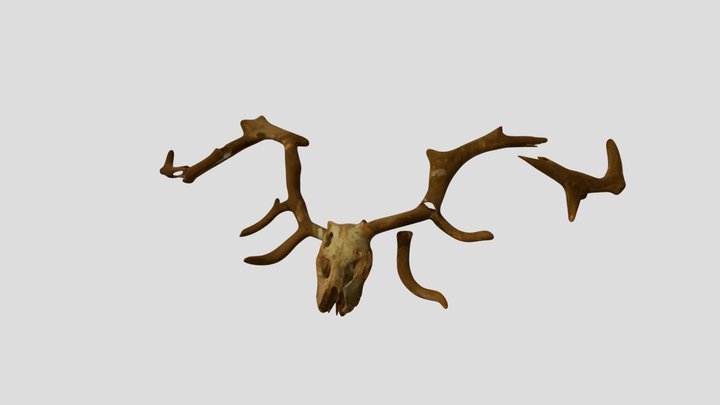
3D model
- Source
- Sketchfab
- Credit
- alessio.langella
- Licence
- CC Attribution
- Commercial use
- cannot be read from the licence given — check the record
No picture of Praemegaceros verticornis was found. Wikidata and iDigBio were searched and had none.
Wikipedia has a picture filed under this name, but nothing tied it to Praemegaceros verticornis itself, so it was not used.
Smithsonian Open Access did not answer, so this is what the others held rather than everything there is.
GBIF was asked, and what came back is not recorded: nothing, or a picture this site could not tie to Praemegaceros verticornis, or no answer at all. This entry cannot say which.
Smithsonian Open Access was not reached for this taxon, so this list is what the others held rather than everything there is.
This is what the site found, which is not the same as what exists.
Keep going
What may have been alongside itPraemegaceros through timeFormations of the PleistoceneThe world it lived on
Occurrence data from the Paleobiology Database, CC BY 4.0. Dawkins 1872