Tursiops truncatus
The common bottlenose dolphin or Atlantic bottlenose dolphin is one of three species of bottlenose dolphin in the genus Tursiops. While formerly known simply as the bottlenose dolphin, this term is now applied to the genus Tursiops as a whole. As considerable genetic variation has been described within this species, even between neighboring populations, many experts think additional species may be recognized and split out.

NASA · Public Domain · via Wikipedia/Commons. May be a photograph of a specimen, or an artist’s reconstruction — an interpretation of a skeleton, since colour and soft tissue are almost never preserved.
On record
Recorded, not inferred- Also called
- common bottlenose dolphinPBDB
- Sits inside
- TursiopsPBDB
- Diet
- piscivore, carnivorePBDB, for Delphinidae
- Life habit
- aquatic, depth=surfacePBDB, for Cetacea
- Motility
- actively mobilePBDB, for Cetacea
- Environment
- marine,freshwaterPBDB, for Odontoceti
Time the record covers
At least 762 thousand years on record.
The record covers at least 774 ka to 11.7 ka. No occurrence read is dated outside 2.58 Mya to 0 Mya.
30 occurrences of Tursiops truncatus on record. The Paleobiology Database records this as a living group. Bar height is expected occurrences, not a count: each fossil is spread across the span it is dated to, so a tall narrow bar means tight dating and a low wide one means loose.
When
30 occurrences- Pleistocene23%
- Holocene77%
These are dates about fossils, not the animal: the record can only begin after it arose and end before it died out, so either end may reach further. Shares are expected occurrences: a fossil dated to a span is counted partly in each period it straddles. More on what this infers.
Found in
2 formations
Loading coastlines…
The named rock units Tursiops truncatus has been recovered from, largest first. Drawn where the rock is now, not where it formed. 28 occurrences have no formation on record, which is common for older literature.
Found in the same rock
90 taxa- Delphinus delphis6 sites
- Cervus elaphus3 sites
- Phocoena phocoena3 sites
- Sus scrofa3 sites
- Bos primigenius2 sites
- Canis lupus2 sites
- Capreolus capreolus2 sites
- Cetacea2 sites
- Cetacea indet.2 sites
- Delphinidae2 sites
- Equus caballus2 sites
- Felis2 sites
- Globicephala macrorhynchus2 sites
- Grampus griseus2 sites
- Monachus monachus2 sites
- Panthera pardus2 sites
- Pseudorca crassidens2 sites
- Alces alces1 site
- Allohippus stenonis1 site
- Apodemus sylvaticus1 site
- Arvicola terrestris1 site
- Balaena mysticetus1 site
- Balaenoptera musculus1 site
- Balaenoptera physalus1 site
The Paleobiology Database records 29 sites for Tursiops truncatus, and this reads all of them. The number is how many of those sites it was catalogued from too. The 24 sharing the most are listed.
This is not a list of everything alive at the time. It is only what has come out of the same ground as this animal and been written down.
Entered from
21 references- Abundance and density of cetaceans in the California Current ecosystem5
- Earliest Records of Holocene Cetaceans in the Black Sea3
- Remarkable mandibular fracture healing in an early Holocene bottlenose dolphin (Tursiops truncatus)2
- Catalog of Living Whales2
- Lydekker, 18872
- Determining the ages of sub-fossil cetacean remains, found in the Carse of Stirling, Scotland1
- The occurrence of the coronuloid barnacle Chelonibia Leach, 1817 as an encruster on mammalian bone in the central Mediterranean Sea1
- Exploitation of dolphins (Cetacea: Delphinidae) at a 6000 yr old Preceramic site in the Pearl Island archipelago, Panama1
- Revalidation of Tursiops gephyreus Lahille, 1908 (Cetartiodactyla: Delphinidae) from the southwestern Atlantic Ocean1
- Humans and marine resource interaction reappraised: Archaeofauna remains during the late Pleistocene and Holocene in Cantabrian Spain1
- A New Dolphin Species, the Burrunan Dolphin Tursiops australis sp. nov., Endemic to Southern Australian Coastal Waters1
- Late Pleistocene and Holocene whale remains (Cetacea) from Denmark and adjacent countries: Species, distribution, chronology, and trace element concentrations1
Each of the 30 occurrences read was entered from one of these publications, ordered by how many each accounts for. This is not a search for papers mentioning the name. 9 further references are not listed. Entries link to doi.org where the Paleobiology Database holds an identifier, and to its own record where it does not. Relayed as the Paleobiology Database holds them, not checked against what they resolve to.
Media and terms
Media content2

Picture of Tursiops truncatus
- Source
- Wikipedia/Commons
- Credit
- NASA
- Licence
- Public Domain
- Commercial use
- the licence allows it
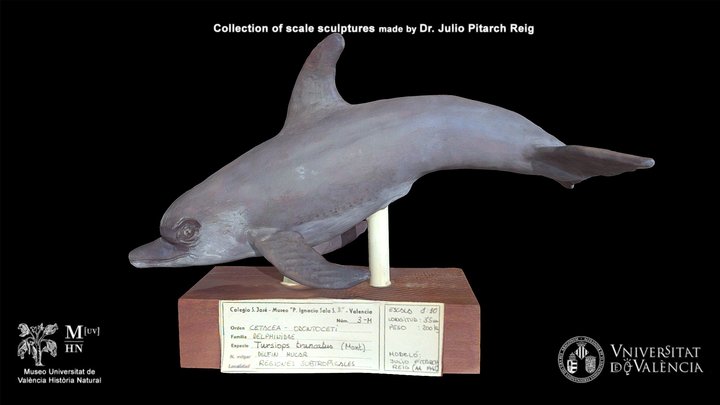
3D model
- Source
- Sketchfab
- Licence
- CC Attribution
- Commercial use
- cannot be read from the licence given — check the record
Smithsonian Open Access and MorphoSource were not reached for this taxon, so this list is what the others held rather than everything there is.
The description on this site
- Licence
- CC BY-SA 4.0
This is what the site found, which is not the same as what exists.
Keep going
What may have been alongside itTursiops through timeThe world it lived on
Occurrence data from the Paleobiology Database, CC BY 4.0. (Gray 1866)