Lepidosauria
The Lepidosauria is a superorder of reptiles, containing the orders Squamata and Rhynchocephalia. Squamata, comprising lizards and snakes, contains over 9,000 species, making it by far the most species-rich and diverse order of non-avian reptiles in the present day. Rhynchocephalia was a formerly widespread and diverse group of reptiles in the Mesozoic Era. However, it is represented by only one living species: the tuatara, a superficially lizard-like reptile native to New Zealand.

Sid Mosdell safaritravelplus Kylez315 LiquidGhoul Patricia Guillory · CC BY 2.0 · via Wikipedia/Commons. May be a photograph of a specimen, or an artist’s reconstruction — an interpretation of a skeleton, since colour and soft tissue are almost never preserved.
On record
Recorded, not inferred- Also called
- lepidosaurPBDB
- Sits inside
- LepidosauromorphaPBDB
- Motility
- actively mobilePBDB, for Osteichthyes
- Environment
- terrestrialPBDB, for Amniota
Time the record covers
At least 248 million years on record.
The record covers at least 248.6 Mya to 11.7 ka. No occurrence read is dated outside 251.902 Mya to 0 Mya.
371 occurrences of Lepidosauria on record, most of them in the Late Triassic. The Paleobiology Database records this as a living group. Bar height is expected occurrences, not a count: each fossil is spread across the span it is dated to, so a tall narrow bar means tight dating and a low wide one means loose.
When
371 occurrences- Early Triassic1%
- Middle Triassicunder 1%
- Late Triassic36%
- Early Jurassic13%
- Middle Jurassic3%
- Late Jurassic23%
- Early Cretaceous9%
- Late Cretaceous8%
- Paleoceneunder 1%
- Eoceneunder 1%
- Mioceneunder 1%
- Plioceneunder 1%
- Pleistoceneunder 1%
- Holocene3%
These are dates about fossils, not the animal: the record can only begin after it arose and end before it died out, so either end may reach further. Shares are expected occurrences: a fossil dated to a span is counted partly in each period it straddles. More on what this infers.
Found in
74 formations
- Morrison Formation40
- Hell Creek Formation · Montana Group18
- La Boca Formation · Huizachal Group13
- Tecovas Formation · Chinle Group10
- Solnhofen Formation9
- Klettgau Formation · Keuper Group8
Loading coastlines…
The named rock units Lepidosauria has been recovered from, largest first. Drawn where the rock is now, not where it formed. 50 further formations hold fewer occurrences each and are not listed. 118 occurrences have no formation on record, which is common for older literature.
Lepidosauria and its relatives
Late TriassicWhere Lepidosauria and its relatives were recorded in the Late Triassic.
Found in the same rock
1,786 taxa- Theropoda44 sites
- Sphenodontia32 sites
- Mammalia30 sites
- Pterosauria26 sites
- Caudata22 sites
- Actinopterygii21 sites
- Sphenodontidae21 sites
- Clevosaurus20 sites
- Archosauria19 sites
- Crocodylomorpha19 sites
- Anura18 sites
- Ceratopsidae17 sites
- Testudines17 sites
- Trionychidae17 sites
- Borealosuchus sternbergii16 sites
- Goniopholis16 sites
- Opisthias16 sites
- Ornithischia16 sites
- Cyclurus fragosus15 sites
- Lepisosteus occidentalis15 sites
- Osteichthyes15 sites
- Rhynchocephalia15 sites
- Richardoestesia isosceles15 sites
- Sphenodon15 sites
The Paleobiology Database records 256 sites for Lepidosauria, and this reads 240 of them. The number is how many of those sites it was catalogued from too. The 24 sharing the most are listed.
This is not a list of everything alive at the time. It is only what has come out of the same ground as this animal and been written down.
Entered from
185 references- Assemblages of small tetrapods from British Late Triassic fissure deposits18
- Vertebrate biostratigraphy of the Hell Creek Formation in southwestern North Dakota and northwestern South Dakota16
- The ecology of a Late Triassic reptile assemblage from Gloucestershire, England15
- Paleoecological analysis of the vertebrate fauna of the Morrison Formation (Upper Jurassic), Rocky Mountain region, U.S.A.14
- Les rhynchocephales et les pterosauriens a crete parietale du Kimeridgien superieur-Berriasien d'Europe occidentale: le gisement de Canjuers (Var-France) et ses abords14
- Quaternary fossil fauna of South Canterbury, South Island, New Zealand11
- Mesozoic lepidosauromorphs of Mexico: a review and discussion of taxonomic assignments10
- Late Triassic microvertebrates from the lower Chinle Group (Otischalkian-Adamanian: Carnian), southwestern U.S.A.8
- Les Rhynchocéphales et les Sauriens des Calcaires lithographiques (Jurassique supérieur) d’Europe occidentale7
- The Late Triassic lepidosaur fauna from Hallau, North-Eastern Switzerland, and a new ‘basal’ rhynchocephalian Deltadectes elvetica gen. et sp. nov.6
- New Triassic sphenodontids from south-west England and a review of their classification6
- A distinctive Late Triassic microvertebrate fissure fauna and a new species of Clevosaurus (Lepidosauria: Rhynchocephalia) from Woodleaze Quarry, Gloucestershire, UK5
Each of the 371 occurrences read was entered from one of these publications, ordered by how many each accounts for. This is not a search for papers mentioning the name. 173 further references are not listed. Entries link to doi.org where the Paleobiology Database holds an identifier, and to its own record where it does not. Relayed as the Paleobiology Database holds them, not checked against what they resolve to.
Media and terms
Media content1
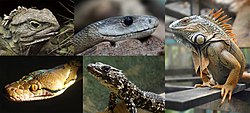
Picture of Lepidosauria
- Source
- Wikipedia/Commons
- Credit
- Sid Mosdell safaritravelplus Kylez315 LiquidGhoul Patricia Guillory
- Licence
- CC BY 2.0
- Commercial use
- the licence allows it
No 3D scan was found. Smithsonian Open Access, MorphoSource and Sketchfab were all searched.
The description on this site
- Licence
- CC BY-SA 4.0
This is what the site found, which is not the same as what exists.
Keep going
What may have been alongside itLepidosauromorpha through timeFormations of the Late TriassicThe world it lived on
Occurrence data from the Paleobiology Database, CC BY 4.0. (Haeckel 1866)