Spheniscus
The banded penguins are penguins that belong to the genus Spheniscus. There are four living species, all with similar banded plumage-patterns. They are sometimes also known as "jack-ass penguins" due to their loud locator-calls sounding similar to a donkey braying. Common traits include a band of black that runs around their bodies bordering their black dorsal coloring, black beaks with a small vertical white band, distinct spots on their bellies, and a small patch of unfeathered or thinly feathered skin around their eyes and underdeveloped fluff sack that can be either white or pink. All members of this genus lay eggs and raise their young in nests situated in burrows or in natural depressions in the earth.

Adrian Pingstone · Public Domain · via Wikipedia/Commons. May be a photograph of a specimen, or an artist’s reconstruction — an interpretation of a skeleton, since colour and soft tissue are almost never preserved.
On record
Recorded, not inferred- Sits inside
- SpheniscidaePBDB
- Diet
- carnivorePBDB, for Coelurosauria
- Life habit
- ground dwelling, solitaryPBDB, for Theropoda
- Motility
- actively mobilePBDB, for Theropoda
- Environment
- marinePBDB, for Sphenisciformes
Time the record covers
At least 7.2 million years on record.
The record covers at least 7.246 Mya to 11.7 ka. No occurrence read is dated outside 23.04 Mya to 0 Mya.
25 occurrences of Spheniscus on record, most of them in the Miocene. The Paleobiology Database records this as a living group. Bar height is expected occurrences, not a count: each fossil is spread across the span it is dated to, so a tall narrow bar means tight dating and a low wide one means loose.
When
25 occurrences- Miocene59%
- Pliocene17%
- Pleistocene12%
- Holocene12%
These are dates about fossils, not the animal: the record can only begin after it arose and end before it died out, so either end may reach further. Shares are expected occurrences: a fossil dated to a span is counted partly in each period it straddles. More on what this infers.
Found in
8 formations
- Pisco Formation7
- Bahía Inglesa Formation6
- Varswater Formation1
- Caleta Herradura de Mejillones Formation1
- Coquimbo Formation1
- Fisher Bench Formation · Pagodroma Group1
Loading coastlines…
The named rock units Spheniscus has been recovered from, largest first. Drawn where the rock is now, not where it formed. 6 occurrences have no formation on record, which is common for older literature.
Spheniscus and its relatives
MioceneWhere Spheniscus and its relatives were recorded in the Miocene.
Found in the same rock
242 taxa- Phalacrocorax7 sites
- Carcharodon hastalis6 sites
- Sula6 sites
- Cetotheriidae5 sites
- Monachinae5 sites
- Myliobatis5 sites
- Otodus megalodon5 sites
- Phocidae5 sites
- Spheniscidae5 sites
- Alosidae4 sites
- Balaenopteridae4 sites
- Carcharhinus4 sites
- Pelagornithidae4 sites
- Phalacrocorax capensis4 sites
- Phocoenidae4 sites
- Puffinini4 sites
- Acrophoca3 sites
- Acrophoca longirostris3 sites
- Carcharodon carcharias3 sites
- Isurus3 sites
- Larus dominicanus3 sites
- Megatheriidae3 sites
- Morus capensis3 sites
- Pelagornis3 sites
The Paleobiology Database records 22 sites for Spheniscus, and this reads all of them. The number is how many of those sites it was catalogued from too. The 24 sharing the most are listed.
This is not a list of everything alive at the time. It is only what has come out of the same ground as this animal and been written down.
Entered from
17 references- Nuevos registros de aves fosiles en la Formacion Bahia Inclesa (Mioceno-Plioceno), Region de Atacama, Chile3
- Una nueva especie de Spheniscus (Aves: Spheniscidae) de la Formacion Pisco, Peru3
- Seasonal exploitation of seabirds by Late Holocene coastal foragers: Analysis of modern and archaeological data from Western Cape, South Africa3
- Revalidation of Tursiops gephyreus Lahille, 1908 (Cetartiodactyla: Delphinidae) from the southwestern Atlantic Ocean2
- Sobre la presencia de Paraptenodytes y Palaeospheniscus (Aves: Sphenisciformes) en la Formacion Bahia Inglesa, Chile2
- Did the giant extinct shark Carcharocles megalodon target small prey? Bite marks on marine mammal remains from the late Miocene of Peru1
- A new late Miocene condor (Aves, Cathartidae) from Peru and the origin of South American condors1
- The first record of fossil penguins from East Antarctica1
- Una nueva localidad con vertebrados marinos del Neógeno de la Formación bahía Inglesa salado, Atacama, Norte de Chile1
- Review of fossil phocid and otariid seals from the southern and western coasts of South Africa1
- The oldest fossil record of the extant penguin genus Spheniscus--a new species from the Miocene of Peru1
- Ramphastosula (aves, Sulidae): a new genus from the early Pliocene of the Pisco Formation, Peru1
Each of the 25 occurrences read was entered from one of these publications, ordered by how many each accounts for. This is not a search for papers mentioning the name. 5 further references are not listed. Entries link to doi.org where the Paleobiology Database holds an identifier, and to its own record where it does not. Relayed as the Paleobiology Database holds them, not checked against what they resolve to.
Media and terms
Media content2
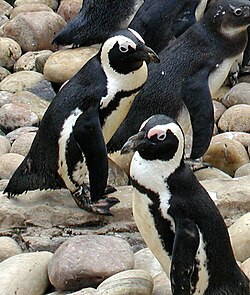
Picture of Spheniscus
- Source
- Wikipedia/Commons
- Credit
- Adrian Pingstone
- Licence
- Public Domain
- Commercial use
- the licence allows it
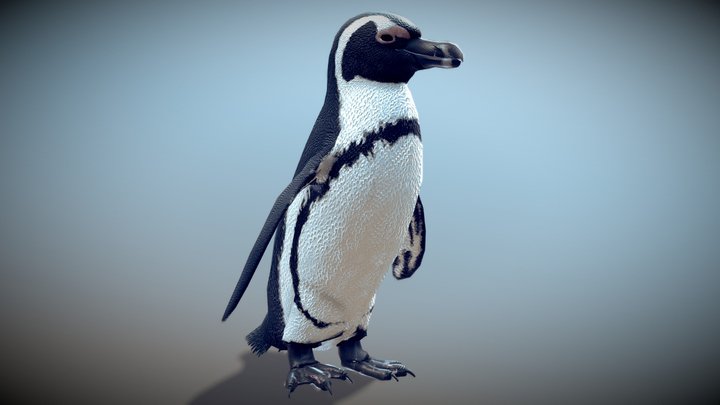
Smithsonian Open Access and MorphoSource were not reached for this taxon, so this list is what the others held rather than everything there is.
The description on this site
- Licence
- CC BY-SA 4.0
This is what the site found, which is not the same as what exists.
Keep going
What may have been alongside itSpheniscidae through timeFormations of the MioceneThe world it lived on
Occurrence data from the Paleobiology Database, CC BY 4.0. Brisson 1760