Symmetrodonta
Symmetrodonta is a group of Mesozoic mammals and mammal-like synapsids characterized by the triangular aspect of the molars when viewed from above, and the absence of a well-developed talonid. The traditional group of 'symmetrodonts' ranges in age from the latest Triassic to the Late Cretaceous, but most research in the last 20-30 years has concluded that they are not a true taxonomic group, but include several unrelated branches of the mammal tree. Despite this, the name is still used informally by some researchers for convenience, usually restricted to the spalacotheriids and zhangheotheriids.

Laikayiu · CC BY-SA 3.0 · via Wikipedia/Commons. May be a photograph of a specimen, or an artist’s reconstruction — an interpretation of a skeleton, since colour and soft tissue are almost never preserved.
On record
Recorded, not inferred- Also called
- symmetrodontPBDB
- Sits inside
- AllotheriaPBDB
- Diet
- insectivorePBDB, for Mammaliaformes
- Life habit
- scansorialPBDB, for Mammaliaformes
- Motility
- actively mobilePBDB, for Osteichthyes
- Environment
- terrestrialPBDB, for Mammalia
Time the record covers
At least 129 million years on record.
The record covers at least 201.4 Mya to 72.2 Mya. No occurrence read is dated outside 205.7 Mya to 66 Mya.
28 occurrences of Symmetrodonta on record, most of them in the Late Jurassic. Bar height is expected occurrences, not a count: each fossil is spread across the span it is dated to, so a tall narrow bar means tight dating and a low wide one means loose.
When
28 occurrences- Late Triassic11%
- Early Jurassic9%
- Middle Jurassic2%
- Late Jurassic34%
- Early Cretaceous27%
- Late Cretaceous18%
These are dates about fossils, not the animal: the record can only begin after it arose and end before it died out, so either end may reach further. Shares are expected occurrences: a fossil dated to a span is counted partly in each period it straddles. More on what this infers.
Found in
11 formations
- Morrison Formation6
- Ilek Formation4
- Ksar Metlili Formation3
- Straight Cliffs Formation2
- Lourinhã Formation2
- Kota Formation · Gondwana Group2
Loading coastlines…
The named rock units Symmetrodonta has been recovered from, largest first. Drawn where the rock is now, not where it formed. 3 occurrences have no formation on record, which is common for older literature.
Symmetrodonta and its relatives
Late JurassicWhere Symmetrodonta and its relatives were recorded in the Late Jurassic.
Found in the same rock
429 taxa- Theropoda12 sites
- Anura9 sites
- Mammalia9 sites
- Pterosauria9 sites
- Coelurosauria8 sites
- Dromaeosauridae8 sites
- Dryolestidae6 sites
- Scincomorpha6 sites
- Actinopterygii5 sites
- Goniopholis5 sites
- Multituberculata5 sites
- Ornithopoda5 sites
- Sauropoda5 sites
- Squamata5 sites
- Atoposauridae4 sites
- Camarasaurus4 sites
- Caudata4 sites
- Choristodera4 sites
- Crocodylomorpha4 sites
- Dorsetisaurus4 sites
- Ornithischia4 sites
- Paramacellodus4 sites
- Sphenodontia4 sites
- Testudinata4 sites
The Paleobiology Database records 25 sites for Symmetrodonta, and this reads all of them. The number is how many of those sites it was catalogued from too. The 24 sharing the most are listed.
This is not a list of everything alive at the time. It is only what has come out of the same ground as this animal and been written down.
Entered from
20 references- New data on the microvertebrate fauna from the Upper Jurassic or lowest Cretaceous of Ksar Metlili (Anoual Syncline, eastern Morocco)3
- Symmetrodonts from the Late Cretaceous of southern Utah and distribution of archaic mammals in the Cretaceous of North America3
- Mammal remains from the Lower Cretaceous Bol'shoi Terekhtyul' locality in West Siberia, Russia2
- Paleoecological analysis of the vertebrate fauna of the Morrison Formation (Upper Jurassic), Rocky Mountain region, U.S.A.2
- Reassessment of the late Triassic symmetrodont mammal Woutersia2
- Mesozoic Mammalia. II: Tinodon and its allies2
- First salamander from the Lower Cretaceous of Germany1
- A new genus of triconodont mammals from the Early Cretaceous of western Siberia1
- The Late Jurassic mammal Docodon, from the Morrison Formation of The Black Hills, Wyoming: implications for abundance and biogeography of the genus1
- A new microvertebrate assemblage from the Upper Jurassic Morrison Formation, including mammals, theropods, and sphenodontians1
- Lusitanisuchus, a new generic name for Lisboasaurus mitracostatus (Crocodylomorpha: Mesoeucrocodylia), with a description of new remains from the Upper Jurassic (Kimmeridgian) and Lower Cretaceous (Berriasian) of Portugal1
- Predvaritel'nye rezul'taty izucheniy mestonakhozhdenii Shestakovskogo kompleksa rannemelovykh pozvonochnykh [Preliminary results of the investigation of the Shestakovo localities of Early Cretaceous vertebrates]1
Each of the 28 occurrences read was entered from one of these publications, ordered by how many each accounts for. This is not a search for papers mentioning the name. 8 further references are not listed. Entries link to doi.org where the Paleobiology Database holds an identifier, and to its own record where it does not. Relayed as the Paleobiology Database holds them, not checked against what they resolve to.
Media and terms
Media content1
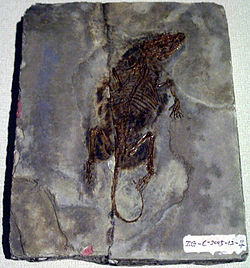
Picture of Symmetrodonta
- Source
- Wikipedia/Commons
- Credit
- Laikayiu
- Licence
- CC BY-SA 3.0
- Commercial use
- the licence allows it
No 3D scan of Symmetrodonta was found in MorphoSource and Sketchfab.
Smithsonian Open Access was not reached for this taxon, so this list is what the others held rather than everything there is.
The description on this site
- Licence
- CC BY-SA 4.0
This is what the site found, which is not the same as what exists.
Keep going
What may have been alongside itAllotheria through timeFormations of the Late JurassicThe world it lived on
Occurrence data from the Paleobiology Database, CC BY 4.0. (Simpson 1925)